Category: Uncategorized

  • Full-Color Custom Beach Towels: Dye Sublimation vs Reactive Printing

    Full-Color Custom Beach Towels: Dye Sublimation vs Reactive Printing

    Once you decide a custom beach towel should carry a full-color design that runs edge to edge, you have quietly made a materials decision as much as an art decision. The print method you can use is dictated by the fiber under it, and the fiber you choose changes how the towel feels, how well it dries, how long the graphic survives the wash, and what it costs. This guide walks through the two dominant routes for branded beach towels, dye sublimation on polyester and dyed or screen printing on cotton, so you can specify the one that matches the job instead of discovering the trade-off after the sample arrives.

    Why a full-color towel is really a fiber choice

    Print chemistry only bonds to certain fibers. Dye sublimation, the process behind photographic, all-over towel prints, works by turning solid ink into a gas under heat and pressure so it bonds into polyester at a molecular level. That bond is the reason the design cannot crack or peel, but it also means the process needs polyester to bond to. A 100% cotton towel has nothing for sublimation ink to fuse with. Cotton takes color through a different family of methods, reactive and pigment dyeing or screen printing, where the colorant sits in or on the cotton fiber itself. So the first fork is not really “which print looks best,” it is “do I want a polyester-faced towel I can cover in a photo, or a cotton towel I brand more simply.” Everything else follows from that.

    Dye sublimation on polyester, and where it stops

    Sublimation buys you unlimited color, and asks for a compromise in feel. Because the ink is applied as a gas, sublimation prints unlimited colors, gradients and photo-real images with no per-color charge and no white border, which is why resort, event and retail towels with full artwork are almost always sublimated. The heat step typically runs in the neighborhood of 385 to 400 degrees Fahrenheit for roughly 45 to 60 seconds, though exact settings vary by press and blank. The catch is the surface. To accept the print, the face of the towel is polyester or a high-polyester blend, which feels closer to a resort gift-shop towel than to a plush bath sheet and is modestly less absorbent than pure cotton. A common middle path is a velour towel with a cotton terry loop back for absorbency and a sheared polyester or poly-blend velour face for a smooth, sharp print, which recovers much of the hand feel while keeping the full-color capability.
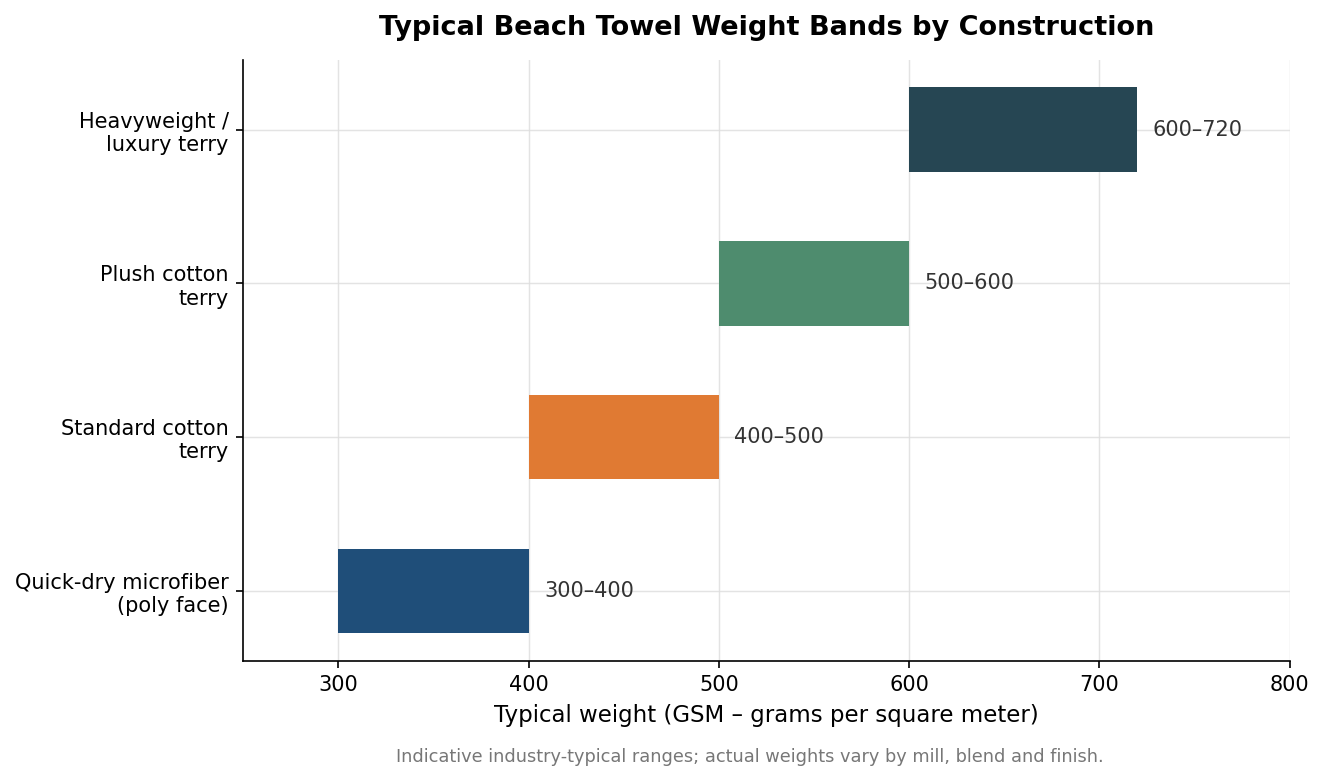
    Horizontal bar chart of typical beach towel GSM weight bands by construction, from quick-dry microfiber at 300-400 GSM to luxury terry at 600-720 GSM
    Typical beach towel weight bands; GSM tracks plushness, absorbency, weight and price.

    The cotton route: reactive dye, screen print, and weave

    Cotton keeps the plush, absorbent hand most buyers expect from a towel. If the priority is a thick, soft, highly absorbent towel and the artwork is a logo or a limited-color design rather than an edge-to-edge photograph, a cotton terry towel branded by screen printing or reactive dyeing is usually the better fit. Screen printing lays ink onto the loops and is economical for simple designs, typically one to four colors, with a setup or per-color fee; heavy, repeated laundering can eventually cause a thick print to crack. Reactive printing bonds dye into the cotton for a softer result that resists fading. For logos meant to last the life of the towel, a woven or jacquard construction builds the design into the cloth itself rather than printing on top, trading fine detail for near-permanent durability. None of these cotton methods reproduces a gradient-rich photo the way sublimation does, which is exactly the trade-off you are weighing.

    Weight and size: reading the numbers on a spec sheet

    GSM is the single most useful number on a towel quote. GSM, grams per square meter, measures density and tracks closely with how plush, absorbent, heavy and expensive a towel feels. Lightweight quick-dry towels, often the polyester-faced microfiber styles, sit around 300 to 400 GSM and pack down small and dry fast. Standard cotton beach towels land roughly in the 400 to 500 GSM band, plush cotton beach towels around 500 to 600, and heavyweight or luxury terry above 600. Higher GSM means more absorbency and a more substantial feel, at the cost of more weight, slower drying and a higher price. For size, 30 by 60 inches is the common baseline; oversized styles around 35 by 70 or 40 by 70 inches read as more premium and give a photographic print more room, but they raise both fabric cost and shipping weight. The chart below shows the weight bands as indicative ranges rather than fixed cutoffs, because mills, blends and finishes shift them.

    Matching the method to the order

    Let the design and the end use pick the method, then let quantity set the budget. If the towel needs full artwork, a gradient, or a photograph and will be used poolside or handed out at an event, sublimated polyester or a velour-faced blend is the practical answer, and you accept a slightly thinner, less plush hand in exchange. If the towel is a giveaway or resale item meant to feel genuinely plush and the branding is a clean logo, cotton terry with a screen or reactive print is the stronger choice. On cost, indicative market pricing tends to run lower for sublimated polyester and higher for cotton with printing, with the exact figure driven by quantity, GSM, size and how many print colors or setups the job needs. Treat the ranges in the chart as planning numbers to frame a conversation with a supplier, not as quotes, and note that setup charges, blank costs and freight sit on top. As a rough planning figure, custom towel programs commonly need a few weeks of production plus transit, so build lead time into any event date and always approve a physical sample before committing to a full run, because color on a screen rarely matches color on terry cloth exactly.
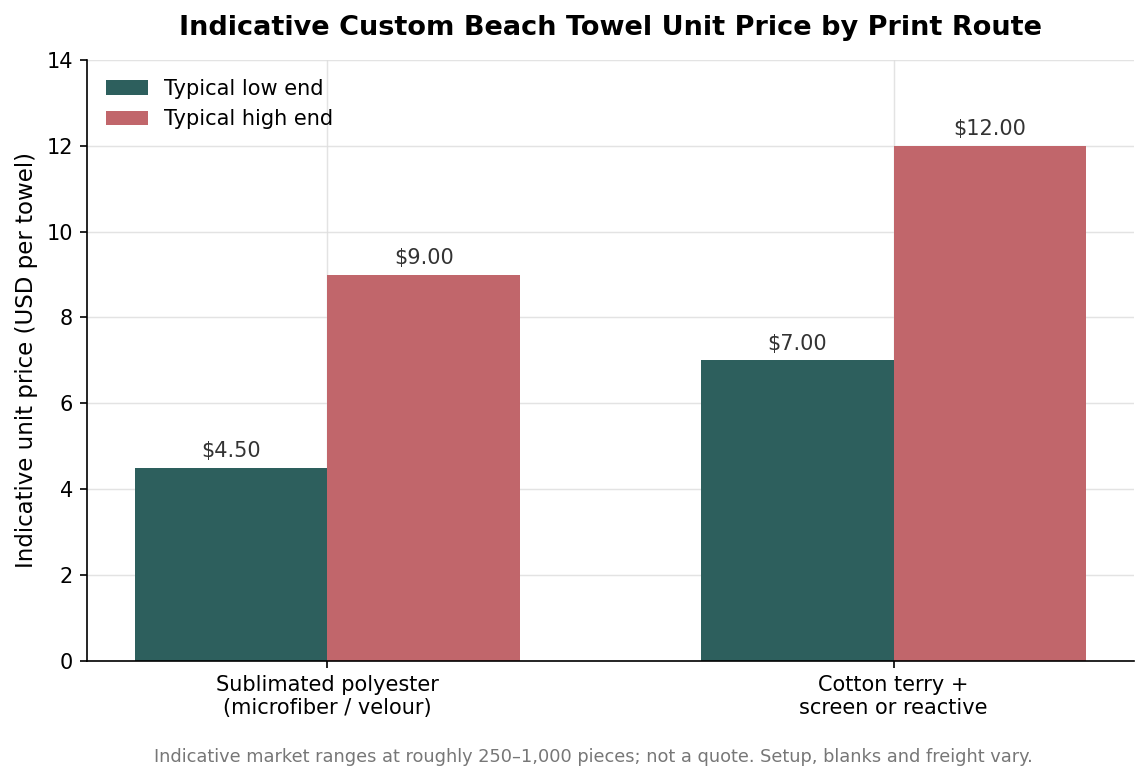
    Grouped bar chart comparing indicative low and high unit prices for sublimated polyester versus cotton terry with screen or reactive printing
    Indicative per-towel price ranges by print route at roughly 250-1,000 pieces.

    The short version: sublimation gives you unlimited, permanent, edge-to-edge color but a more athletic, resort-style hand on a polyester face, while cotton with reactive or screen printing gives you a plush, absorbent towel with simpler branding. Decide which of those two experiences your recipient should have first, confirm the GSM and size against the numbers above, and the print method mostly chooses itself.
  • Why Your Beach Towel Won’t Shed Sand, and Which Construction Fixes It

    Why Your Beach Towel Won’t Shed Sand, and Which Construction Fixes It

    A beach towel has three jobs beyond drying you off, and it either does them or it does not: shed the sand you drag onto it, dry out before you pack it away, and fit in a bag that already holds sunscreen, snacks, and a change of clothes. Whether a towel wins or loses at all three is decided before any logo goes on it, by how the towel is built. Fiber matters, but construction is what makes one towel a sandy, soggy brick and another a shake-and-go favorite. Here is how the main constructions actually perform, and how to pick for the way you use a towel.

    The three constructions worth comparing are classic terry, the looped-pile cloth most people picture; flat-woven Turkish cloth, sold as fouta or peshtemal, which has no pile; and microfiber, a synthetic. Each solves the beach’s three problems differently, and none wins on every axis, which is exactly why the right choice depends on the use rather than on which is best in the abstract.

    Why sand loves terry, and what sheds it

    Sand sticks to terry for a mechanical reason, not a mysterious one. Terry is built from thousands of raised loops, and each loop is a little hook that traps sand grains. You shake the towel, you snap it, and you still carry half the beach home in the pile. This is the same loop structure that makes terry feel plush and absorb so well, so the trait that makes it comfortable is the trait that makes it sandy. There is no shaking your way out of the geometry.

    Flat-woven Turkish cloth attacks the problem at the source: with no loops on the surface, there is nothing for sand to catch on, and a single shake releases it. That is the entire appeal of a fouta at the beach. Microfiber sits in the middle, releasing sand better than terry because its surface is smoother and shorter, though not as cleanly as a true flat weave. If a sandless towel is your top priority, construction settles the question before you even look at color.

    Drying and weight: the density trade-off

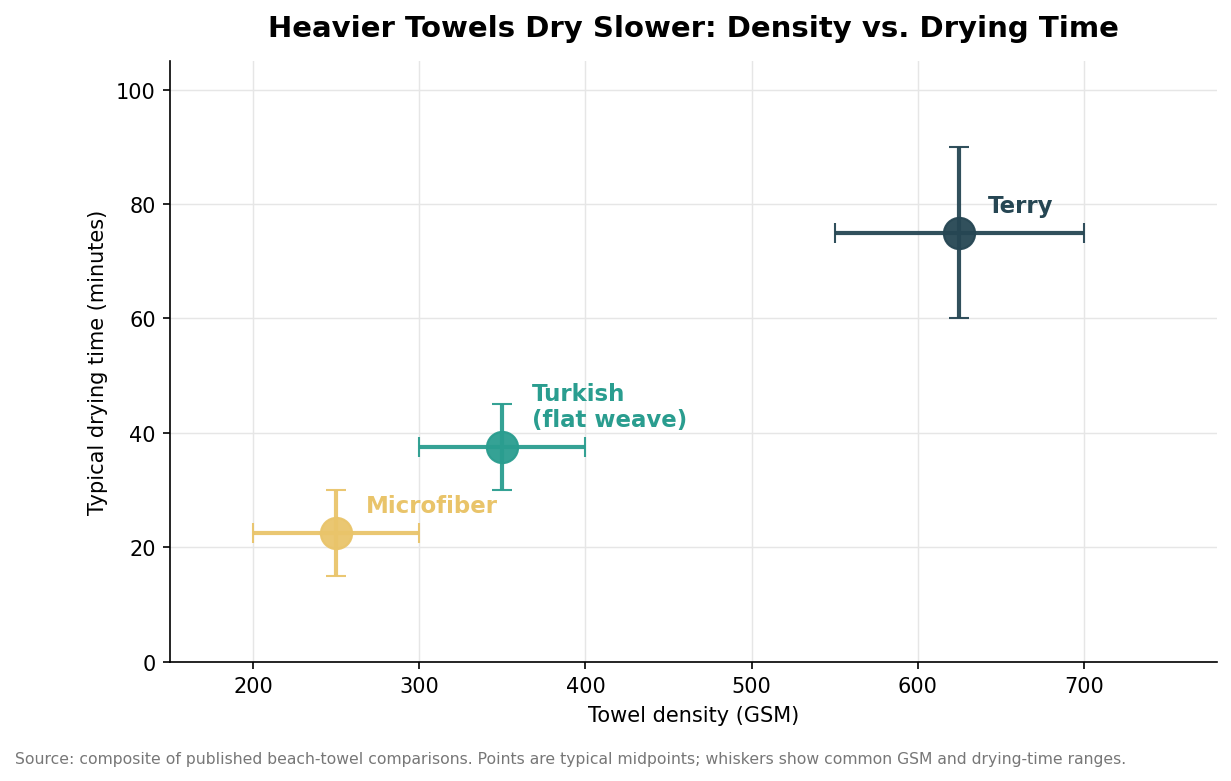
    Drying speed tracks density, and density is measured in GSM, the grams per square meter of the cloth. Lightweight towels run about 300 to 400 GSM, medium weights 400 to 600, and plush premium terry climbs into the 600 to 900 range with thick, thirsty loops. More GSM means more absorbency and a more luxurious hand, but it also means more water held and a longer dry. The numbers are stark: a heavy terry beach towel commonly needs roughly 60 to 90 minutes to dry, a Turkish flat weave at 300 to 400 GSM dries in about 30 to 45 minutes, and microfiber at 200 to 300 GSM can be dry in 15 to 30 minutes. The flat weave dries something like 30 to 50 percent faster than terry despite feeling far from thin.

    Scatter plot of towel density in GSM against typical drying time in minutes for terry, Turkish flat-weave, and microfiber beach towels, with range whiskers, showing heavier towels dry more slowly
    Density versus drying time by construction; points are typical midpoints and whiskers show common ranges.

    The trade-off has a twist worth knowing. A flat weave hits genuinely useful absorbency at only 300 to 400 GSM because the woven structure spreads water across the whole cloth instead of hiding it in deep loops, which is why a Turkish towel feels far more capable than its weight suggests, and why both Turkish and Turkish cotton generally get softer and more absorbent after a few washes rather than matting down. Terry buys its plushness with weight and pays for it in drying time. Microfiber dries fastest of all but can feel slick or clammy against wet skin, a texture some people never warm to.

    What actually fits in the bag

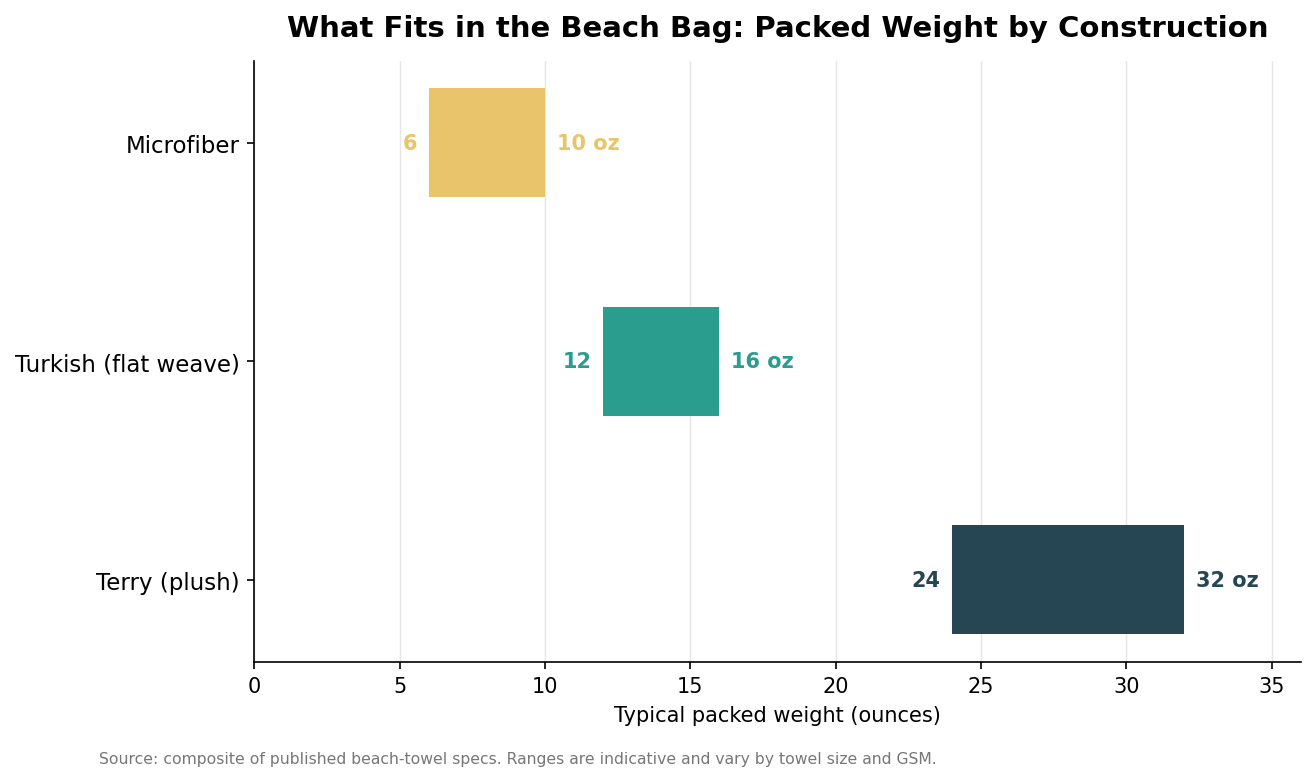
    Bulk is the quiet dealbreaker, especially for travel, boats, and anyone carrying towels for a whole family. Packed weight follows the same density logic: a Turkish towel runs roughly 12 to 16 ounces and folds down to about the size of a paperback, microfiber compresses to a fist at 6 to 10 ounces, and a plush terry beach towel lands around 24 to 32 ounces and eats real space in a bag. Multiply that across four people and the difference between a stack of foutas and a stack of terry is the difference between one tote and two.

    Horizontal range bars of packed towel weight in ounces by construction: microfiber 6 to 10, Turkish 12 to 16, and terry 24 to 32 ounces
    Typical packed weight range by construction; lighter towels pack smaller. Figures are indicative and vary by size and GSM.

    Durability rounds out the picture and does not always favor the plush option. Flat-woven Turkish cotton is commonly cited as lasting a decade or more and improving with age, terry typically thins over three to five years of hard use, and microfiber tends to pill and hold odor within two to four years. Treat these as indicative rather than promises, since laundering and cotton quality swing them, but the ranking is consistent across sources: for longevity, the flat weave usually wins.

    Choosing by how you actually use it

    Match the towel to the day and the decision makes itself. For a plush family beach day or a poolside lounge where comfort beats packing and there is time to dry towels at home, mid-to-heavy terry, in the 500 to 700 GSM range, is still the cozy classic. For travel, surf, boat, and festival use where sand, drying, and bulk all matter at once, a Turkish flat weave is the all-around answer, and microfiber is the ultralight pick when packed size trumps feel. For a resort, rental, or gym program, weigh laundering: flat weave lasts and dries fast on the line, while terry delivers the plush guest experience at the cost of dryer time and storage.

    One construction note for anyone printing a design rather than a simple logo: a smooth surface holds detail better than a looped one. Flat-woven and sheared velour surfaces render full-color and photographic prints crisply, and microfiber sublimates edge-to-edge full-bleed color that cotton cannot match, whereas a deep terry loop softens fine detail as the pile moves. If the towel is a canvas for artwork, let the print method and the construction be chosen together, not one after the other. Decide which of the three beach problems you most need solved, pick the construction that solves it, and the rest of the spec sheet falls into line.

  • Custom Beach Towel Mistakes That Cost You on the Reorder

    Custom Beach Towel Mistakes That Cost You on the Reorder

    Most problems with a custom beach towel order are visible before the towels ship, if you know where to look. They come from a handful of predictable decisions made too fast: a weight chosen for the wrong reason, a print method that does not match the fabric, a size that shrinks past what people expected. None of them are exotic, and every one of them costs money on the reorder rather than the first run. Here are the mistakes worth catching early, in the order they tend to bite.

    Buying bath weight when you needed beach weight

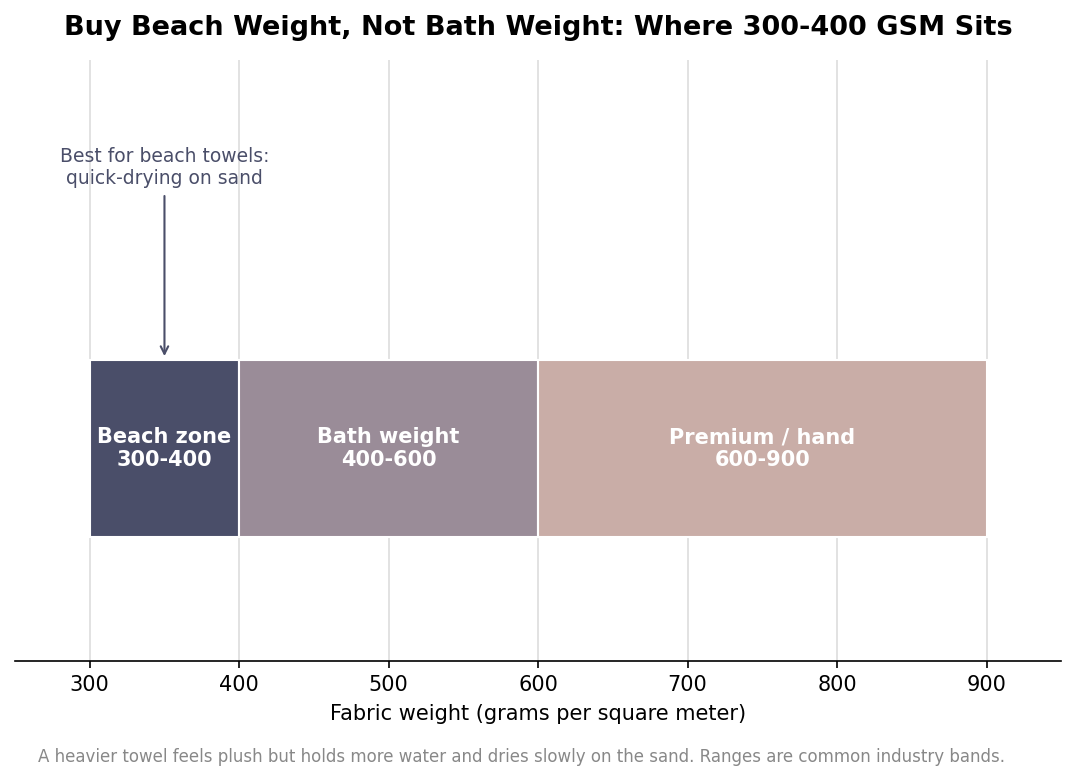
    A plush hand feels reassuring in a showroom and works against you on the sand. Beach towels live in the 300 to 400 gram-per-square-meter band for a reason: they are absorbent enough to dry a person but light enough to dry themselves quickly in the sun. Push up into the 400 to 600 range that suits bath towels and you get a denser towel that holds more water and stays damp for hours, which is exactly wrong for a towel that will be soaked, folded into a bag, and expected to be usable again the same afternoon. The 600 to 900 range is denser still and belongs on hand towels, not the beach. Heavier is not more premium here; it is slower to dry and more expensive to ship and launder.

    Stacked horizontal bar showing GSM ranges with the 300-400 beach zone highlighted
    Beach towels belong in the 300-400 GSM band, below bath and premium weights.

    Trying to sublimate cotton

    The single most common print mismatch is expecting a photographic, edge-to-edge design on a 100% cotton towel. Dye sublimation, the process behind full-bleed, high-resolution towel graphics, bonds dye to polyester fibers; it needs a polyester or high-polyester face to work, which is why sublimated towels are typically a poly microfiber with a smooth velour print side. Cotton fibers do not accept sublimation dye, so a detailed edge-to-edge print on cotton has to come from a different route, usually reactive printing or screen printing, each with its own limits. Screen printing counts colors: every additional flat color is another screen and another cost, and fine gradients or photographs do not translate well. Reactive printing handles more detail but is a different supply chain and lead time. Decide the artwork first. A bold logo in a few flat colors is comfortable and economical on cotton; a full-coverage photographic print effectively chooses a polyester velour base for you, whether or not that was the plan.

    Forgetting that the loops and the back stay white

    Full-bleed only means full-bleed on the surface that was printed. On a poly microfiber towel the velour face takes the design edge to edge while the reverse keeps absorbent terry loops, and on many constructions that back is undyed and reads white. On cotton terry, the raised loops scatter a printed image and any hemmed border stays the base color, so a design that looked seamless on a flat proof shows the towel’s ground color in the texture. This is not a defect; it is how the fabrics are built. The fix is to design with it: keep critical logo elements off the extreme edges, expect a visible border on terry, and ask to see the print on the actual loop or velour surface, not just a flat digital mockup.

    Ordering the wrong size and ignoring shrinkage

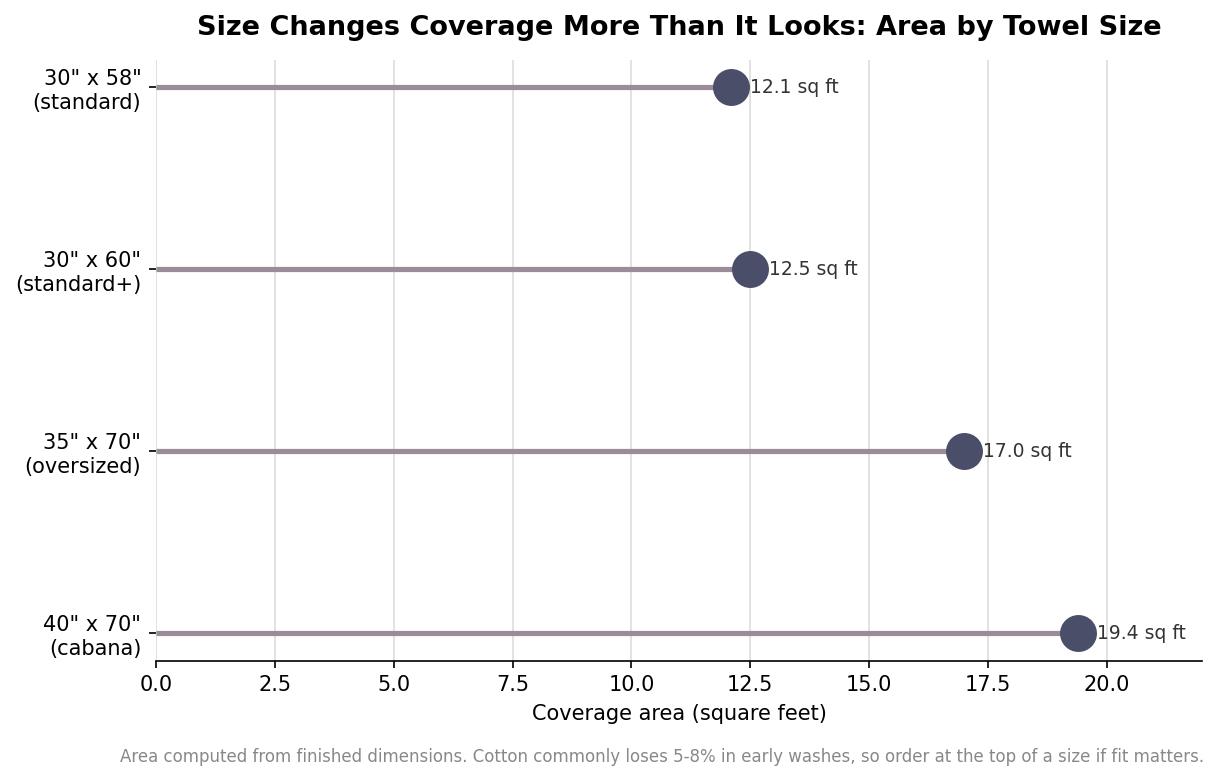
    Two towels that sound similar can differ by a third in real coverage. A standard beach towel runs about 30 by 58 to 30 by 60 inches, while an oversized towel at 35 by 70 jumps from roughly 12 square feet of coverage to about 17, and a 40 by 70 cabana size approaches 19. That is a meaningful difference for an adult lying down, and it is worth deciding deliberately rather than defaulting to the cheapest size. Layer shrinkage on top: cotton commonly loses somewhere in the range of 5 to 8 percent in its first few hot washes, so a towel that measures right off the loom can come back noticeably smaller. If finished size matters, specify toward the top of a size and confirm whether the quoted dimensions are pre-wash or post-wash.

    Lollipop chart comparing coverage area in square feet across four beach towel sizes
    Coverage area rises sharply from standard to oversized and cabana sizes.

    Skipping the pre-production sample and a wash test

    The cheapest insurance in the whole process is one approved sample before the bulk run. A physical pre-production sample lets you check three things a screen cannot: the actual color against a Pantone reference, the hand and weight of the finished fabric, and how the print and the fabric survive laundering. Run that sample through several wash cycles at the temperature it will really face, then look for fading, cracking on a screen print, or a design that has gone soft at the edges. Low-twist pile absorbs better but can look slightly less crisp under a print, another thing you only judge in hand. Confirm the finished head and tail size, the border route, and the packing at the same time. Catching a color that shifts or a print that cracks on a single sample costs a week; catching it on a delivered pallet costs the whole run.

    None of these checks require special expertise, only the discipline to make the decisions in the right order. Fix the weight to how the towel is used, match the print method to the fabric before you fall in love with the artwork, plan around the border and the back you will actually get, size for real coverage after shrinkage, and prove all of it on one sample. Do that and the reorder becomes a repeat of something that worked, rather than a correction of something that did not.

  • Cotton, Blend, or Microfiber: Choosing a Custom Beach Towel Base

    Cotton, Blend, or Microfiber: Choosing a Custom Beach Towel Base

    Most custom beach towel decisions get framed as a color and logo problem, but the choice that quietly determines everything is the base fabric. It sets how the towel feels, how fast it dries, how long it survives a laundry cycle, and, crucially, how you are allowed to print on it. Get the base right and the artwork falls into place. Get it wrong and you are fighting the fabric for the life of the order. Three bases cover the overwhelming majority of custom work: cotton terry, a cotton-polyester blend, and microfiber.

    The fiber decides the print method, not the other way around

    This is the rule that trips up first-time buyers. Dye sublimation, the process behind photo-realistic, edge-to-edge towel designs with no white border, bonds dye directly into polyester fibers. It only works where there is polyester to bond to. A 100 percent cotton towel cannot be sublimated, so its artwork is applied by screen printing or reactive dyeing instead, which handles crisp logos and a handful of spot colors well but cannot reproduce gradients or full-bleed photography. If your design is a bold multicolor pattern that runs to the edge, you are choosing a polyester-bearing base whether you thought about it that way or not. If your design is a clean one to four color logo, cotton is back on the table.

    Cotton terry: the plush, absorbent classic

    Cotton terry is what people picture when they think beach towel. The looped pile gives it the plush hand and the highest absorbency of the three, holding on the order of one and a half times its own weight in water. Beach weights typically land between 450 and 600 GSM, with the heavier end reserved for spa and resort programs where a thick towel signals quality. The trade-offs are weight and drying: a soaked terry towel is heavy in a bag and can take a couple of hours to air dry. Decoration is screen print or embroidery, so keep the artwork to logos and simple graphics, and expect a printed design to soften with heavy laundering over roughly 200 to 300 wash cycles. Cotton is usually the premium option on price as well, often the most expensive base per piece.

    Cotton-polyester blend: the practical middle

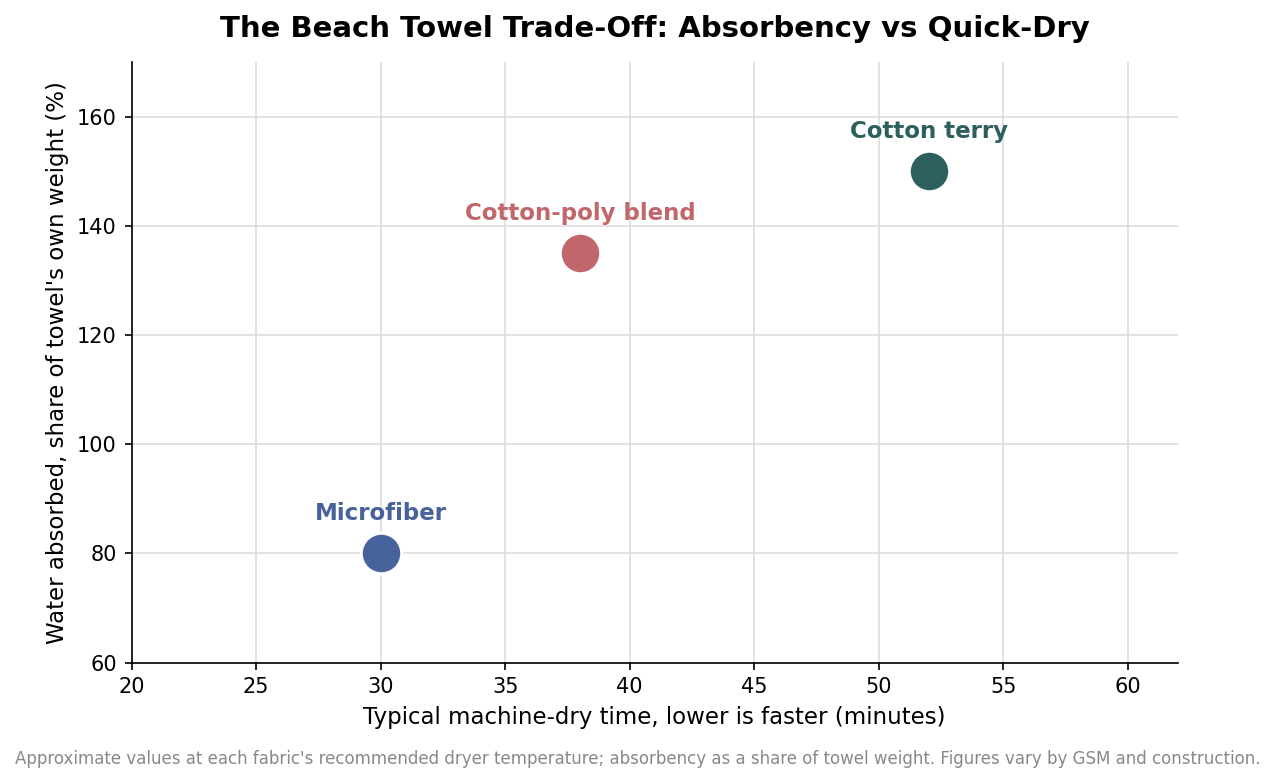
    A blend, commonly around 70 percent cotton and 30 percent polyester, is the pragmatic choice for programs that get washed constantly. It keeps most of the cotton hand and roughly 90 percent of cotton’s absorbency while drying about a quarter faster, and it tends to run 15 to 20 percent cheaper than premium cotton. Its real advantage shows up over time: where pure cotton can fall to around 70 percent of its original absorbency after 200 washes, a good blend holds closer to 85 percent. For hotels, gyms, and rental fleets that value durability and laundry turnaround over maximum plushness, the blend is often the smartest total-cost decision even though it never wins a single spec outright.

    Scatter chart plotting three beach towel fabrics by machine-dry time versus water absorbency, showing cotton most absorbent and microfiber fastest drying
    Cotton terry absorbs the most but dries slowest; microfiber flips both. The blend sits in between.

    Microfiber: lightweight, quick-dry, and built for sublimation

    Microfiber, usually an 80 percent polyester and 20 percent nylon weave around 300 GSM, is the travel and event towel. It is thin and packable, dries three to five times faster than cotton, and because it is largely polyester it takes dye sublimation beautifully, which is why the vibrant, full-coverage promotional towels you see are almost always microfiber or sublimation-grade polyester. It is also the most wash-durable of the three, often lasting 400 to 500 cycles. The honest downsides are feel and absorbency: it holds only about 80 percent of its own weight in water and has a smoother, less plush hand than terry. For a giveaway, a race, a gym, or anything that has to fit in a backpack, that is a fair trade. For a luxury pool experience, it is not.

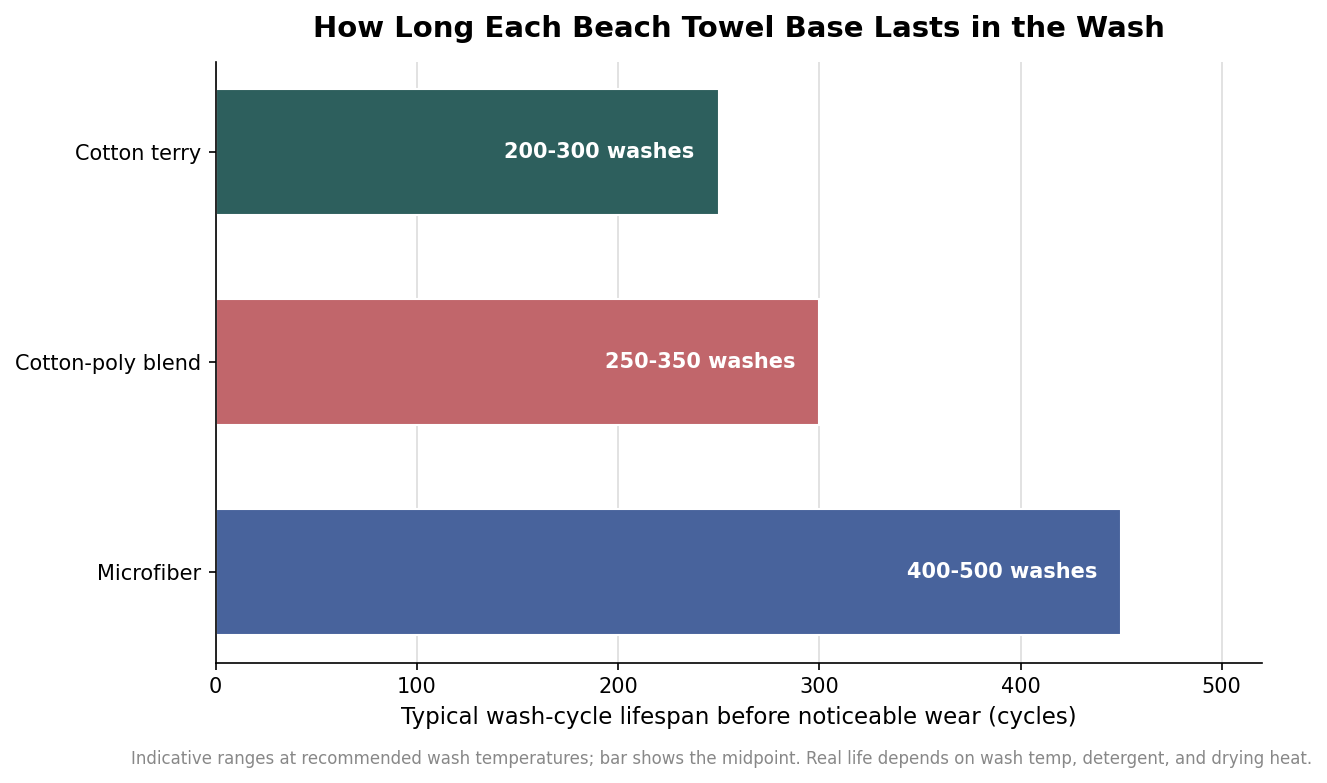
    Horizontal bar chart of typical wash-cycle lifespan for cotton terry, cotton-poly blend, and microfiber beach towels
    Microfiber typically survives the most wash cycles, with the blend outlasting pure cotton.

    Care is part of the spec, not an afterthought

    How the towels are washed determines whether your base performs to its rating. Cotton and blends are happiest around 140 degrees Fahrenheit, roughly 60 Celsius, which sanitizes and lifts oils without cooking the fibers; push much past 160 degrees and you start breaking cotton down and shortening the lifespan you paid for. Microfiber is the opposite temperament and wants cooler water, in the range of 105 to 120 degrees, because high heat can glaze its fibers and kill the quick-dry behavior that was the whole reason you chose it. Skip fabric softener on every base, since it coats the fibers and is the single fastest way to destroy absorbency, and keep dryer heat moderate. Spelling this out for whoever launders the towels, whether that is a hotel service or a customer care card, protects the wash-cycle numbers on the chart above from turning into optimistic fiction.

    Matching GSM and base to the job

    Weight should follow the use case rather than a default. As a rough guide, resort and hotel beach towels sit comfortably in the 400 to 500 GSM range, gym and event towels do their job at 300 to 400 GSM where lighter and quick-drying is a feature, and spa towels climb to 500 to 600 GSM where plushness is the point. Layer the print method on top of that: if the brief calls for a full-bleed photographic design, plan on a polyester or microfiber base and dye sublimation from the start, and if it calls for a sharp logo on a premium feel, cotton terry with screen print or embroidery is the natural fit. Confirm the exact GSM, fiber content, and decoration method on your quote before you approve anything, because those three numbers, more than the price, are what you will live with every time the towel comes out of the wash.

  • Printed, Woven or Embroidered: Which Branding Survives Your Laundry

    The decoration method matters less for how the towel looks on day one than for how it looks on wash sixty. Start with the laundry, not the artwork.

    Printing: dye sublimation

    Sublimation turns ink to gas and bonds it inside the fiber, so full-color artwork, photographs and gradients are all possible edge to edge, and nothing sits on the surface to crack or peel.

    It holds up well through normal domestic washing. It does not hold up through repeated industrial washing with bleach, which is a different thing entirely and the source of most disappointment.

    Weaving: dobby borders and cabana stripes

    A woven border is structure rather than ink: the color is in the yarn, so there is literally nothing to fade off. It survives commercial laundering indefinitely and looks the same after three seasons of chlorine.

    The limitation is resolution. Weaving gives you stripes, bands, simple geometry and blocky marks. It will not give you a detailed logo.

    Embroidery: a stitched mark

    Permanent, quiet and premium, and the right answer when the towel should read as a good towel first and a branded one second. Stitch onto a sheared velour landing panel, never straight into raw loops, or the mark loses its edges within a few washes.

    Thread has a floor of roughly a sixteenth of an inch. Below that, detail becomes a smudge.

    The question that decides it

    Who washes this towel? A guest at home: print it. A commercial laundry: weave or embroider it. That single question resolves the great majority of orders before anyone looks at the artwork.

  • How to Choose a Custom Beach Towel: Fabric, Weight and Size

    Three specifications decide almost everything about how a towel feels and how long it lasts. Get them right and the decoration is the easy part.

    Fabric: cotton or microfiber

    Cotton absorbs into the fiber and feels plush; microfiber traps water between very fine filaments and dries in minutes. Cotton is what people mean when they say towel. Microfiber is what they want when it has to fit in a bag.

    Choose cotton for hotels, spas, gifts and anything premium in the hand. Choose microfiber for race packs, travel kits, festival merchandise and any order where shipping weight is a real cost.

    Weight: what gsm actually means

    Grams per square meter is the honest measure of a towel. Below 300 gsm a cotton towel feels thin immediately. Around 400 is a good retail towel. From 450 to 550 is hotel and spa territory, and it is where the towel starts to feel expensive in the hand rather than in the description.

    Heavier is not automatically better. A 550 gsm towel takes far longer to dry and costs more to ship, which matters for anything posted as a gift.

    Size: standard or oversized

    Standard is 30 by 60 inches. Oversized cabana is 35 by 70. If the towel will be lain on rather than dried with, take the oversized — it is the difference between covering a lounger and almost covering it.

    Almost nobody who upgrades goes back. The trade is weight, both to dry and to post.

    The combinations that work

    Hotel pool: 500 gsm cotton, oversized, woven border. Retail and gifting: 400 gsm velour, standard or oversized, printed. Race and travel: 250 gsm microfiber, standard, printed. Spa: 450 gsm terry, standard, embroidered.

    If your use is not on that list, tell us what it is and we will specify it rather than sell you the middle option.

  • Ordering Branded Towels for a Property or an Event

    A towel order is rarely a one-off. Planning the second order while placing the first is what separates a tidy linen cupboard from a mismatched one.

    Quantities for a property

    The working rule is three sets in circulation for every lounger or room position: one in use, one in the wash, one on the shelf. Properties that order two sets spend the season firefighting.

    Add roughly ten percent for loss. Guests take good towels home, which is a compliment with a cost attached.

    Plan the replacement cycle

    Commercial stock has a life measured in wash cycles, not years. Decide up front whether you will replace the whole set at once or roll a portion each season — rolling replacement keeps the cupboard consistent, which is why we keep your specification and weave on file for identical reorders.

    Monograms and dates for events

    Initials and a date are the two things people keep. A full event logo on a welcome towel gets used once; a monogram gets used for years. If the towel is a gift rather than signage, brand it as lightly as you can bear.

    Color, honestly

    White is the only color that can be bleached hard, which is why properties keep choosing it. If you want color on a commercially laundered towel, put it in a woven border rather than across the whole field.

    What to send us

    The use, the laundry, a rough quantity and your color references. That is enough for us to specify the towel properly and send a free mockup within one business day — and to tell you if the method you had in mind will not survive the wash you have.

  • Custom Beach Towels: Choosing Fabric Weight, Material, and Print Method

    Custom Beach Towels: Choosing Fabric Weight, Material, and Print Method

    A custom beach towel looks like a simple product, but the difference between one that feels cheap and one that a customer keeps for years comes down to three specifications you set before any artwork is applied: fabric weight, fabric type, and print method. Get those right and the towel photographs well, survives repeated washing, and carries your logo cleanly. Get them wrong and you end up with a thin, scratchy giveaway that ends up in a drawer. This guide walks through each decision in the order you should make it.

    Fabric weight is the first thing to lock down

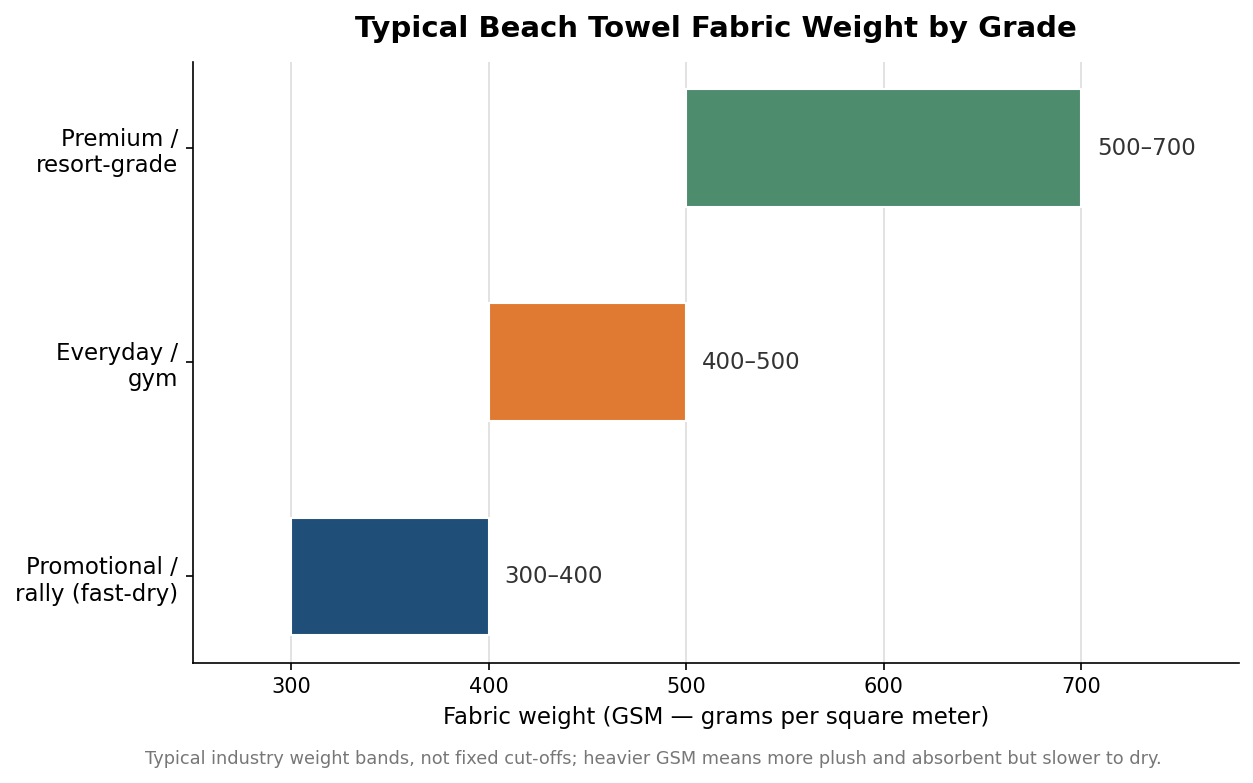
    Weight is measured in GSM, or grams per square meter, and it is the single number that most predicts how a towel feels in the hand. Lighter towels dry faster and cost less to make and ship; heavier towels feel plush and absorb more but take longer to dry. For custom beach and promotional towels, the useful range runs from about 300 GSM at the thin, fast-drying end to roughly 700 GSM at the resort-grade end.

    As a rough map, promotional and rally-style towels sit around 300 to 400 GSM, everyday and gym towels land near 400 to 500 GSM, and premium retail or resort towels run from about 500 to 700 GSM. These are typical industry bands rather than hard cut-offs, and different mills label their weights slightly differently, so always ask for a physical sample before committing to a large run. If the towel is meant to be sold rather than given away, most buyers are happier landing at 450 GSM or above, because that is the point where the fabric starts to feel like a retail product instead of a handout.

    Floating bar chart of typical beach towel fabric weight in GSM by grade: promotional 300-400, everyday 400-500, premium 500-700
    Fabric weight in GSM is the specification that most predicts how a towel feels and dries.

    Cotton, velour, or microfiber: match the fabric to the job

    Cotton terry is the default for a reason. Ring-spun or combed cotton is soft, highly absorbent, and pleasant against skin, which is why it dominates the beach and bath category. The trade-offs are real: cotton is heavier to ship in bulk and slower to dry, and its looped terry surface slightly softens the edges of any printed graphic because ink sinks into the loops. For a plush, absorbent towel where the design is a logo or bold motif rather than fine detail, cotton terry is hard to beat.

    Velour is cotton with a sheared face. The loops on one side are cut to create a smooth, flat surface that takes sharp graphics far better than raw terry, which is why many printed retail towels are terry on the back for absorbency and velour on the front for print quality. Microfiber, usually a polyester or polyamide blend, is the lightweight, quick-drying option favored for sports, travel, and promotional use. It resists shrinking and holds color well, but it is less plush and absorbs less per pass than a high-GSM cotton towel. Blended fabrics such as 70/30 cotton-polyester sit in the middle, resisting shrinkage while keeping much of cotton’s comfort.

    Let your artwork choose the print method

    The print decision follows from the fabric and the design, not the other way around. Dye sublimation produces full-color, edge-to-edge, photographic results and is the method of choice when the entire towel is the canvas, but it bonds to polyester fibers rather than cotton. That means sublimation belongs on microfiber or a poly-faced velour; attempting it on 100 percent cotton gives washed-out, short-lived color. Sublimation files should generally be supplied at around 300 DPI so fine detail holds.

    For cotton, reactive dye printing and screen printing are the workhorses. Reactive and pigment printing uses water-based, often Oeko-Tex certified inks that soak into cotton for a soft hand. Screen printing is the most cost-effective route for bold logos and high-contrast designs once you are ordering in volume, typically becoming economical from around 144 units because the setup cost spreads across the run. If your design is a clean logo in one to three colors, screen printing on cotton terry is usually the most durable and affordable choice; if it is a full-bleed photographic scene, plan on microfiber or velour and sublimation.

    Sizing, minimum orders, and lead time

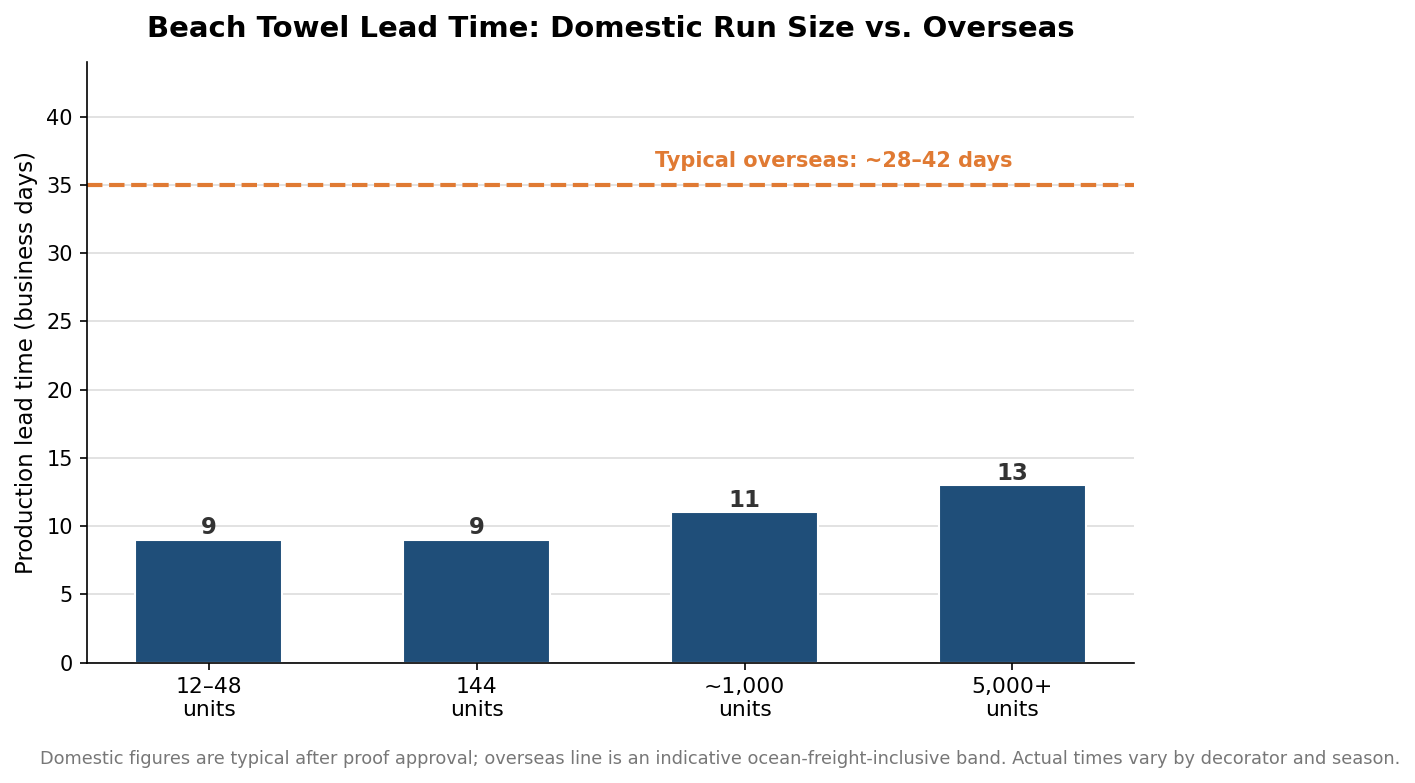
    Standard beach towels commonly run about 30 by 60 inches, with oversized versions around 35 by 70 or 40 by 70 inches for a more premium, lounge-friendly footprint. Larger dimensions raise both the fabric cost and the print area, so decide early whether you are making a compact giveaway or a statement retail piece. Minimum order quantities for custom towels can start as low as 12 units for simple styles, with meaningful price breaks appearing at 144 pieces and larger discounts at the 1,000 and 5,000 unit levels as setup and material costs spread further.

    Lead time is where domestic and overseas production diverge sharply. A domestic decorator will often turn a run in roughly 7 to 10 business days after proof approval, stretching toward 12 to 14 days for very large orders. Overseas manufacturing can lower the per-unit price on big volumes but typically adds four to six weeks once ocean freight is included, which makes it a poor fit for anything tied to an event date. The figures here are indicative and vary by decorator, season, and how quickly you approve the proof, so treat them as planning ranges rather than guarantees.

    Bar chart of domestic beach towel production lead time in business days by order size, with an overseas reference line around 28 to 42 days
    Domestic runs typically finish in days; overseas production trades a lower unit price for weeks of added lead time.

    Building the spec sheet

    When you request a quote, specify all four variables together so the decorator is not guessing: the GSM weight, the fabric type, the finished dimensions, and the print method matched to your artwork. A request that reads “450 GSM cotton terry-velour, 30 by 60 inches, three-color screen print, 250 units” will get you an accurate price and a predictable result. A vague request for “custom beach towels” invites substitutions that surface only when the sample arrives. Order a pre-production sample whenever the run is large or the towel is going to be sold, confirm the ink and fabric certifications if that matters to your buyers, and build your event or launch date backward from the realistic lead time rather than the best case. The towel itself is straightforward; the discipline is in writing the specification down before anyone quotes it.