A custom beach towel looks like a simple product, but the difference between one that feels cheap and one that a customer keeps for years comes down to three specifications you set before any artwork is applied: fabric weight, fabric type, and print method. Get those right and the towel photographs well, survives repeated washing, and carries your logo cleanly. Get them wrong and you end up with a thin, scratchy giveaway that ends up in a drawer. This guide walks through each decision in the order you should make it.
Fabric weight is the first thing to lock down
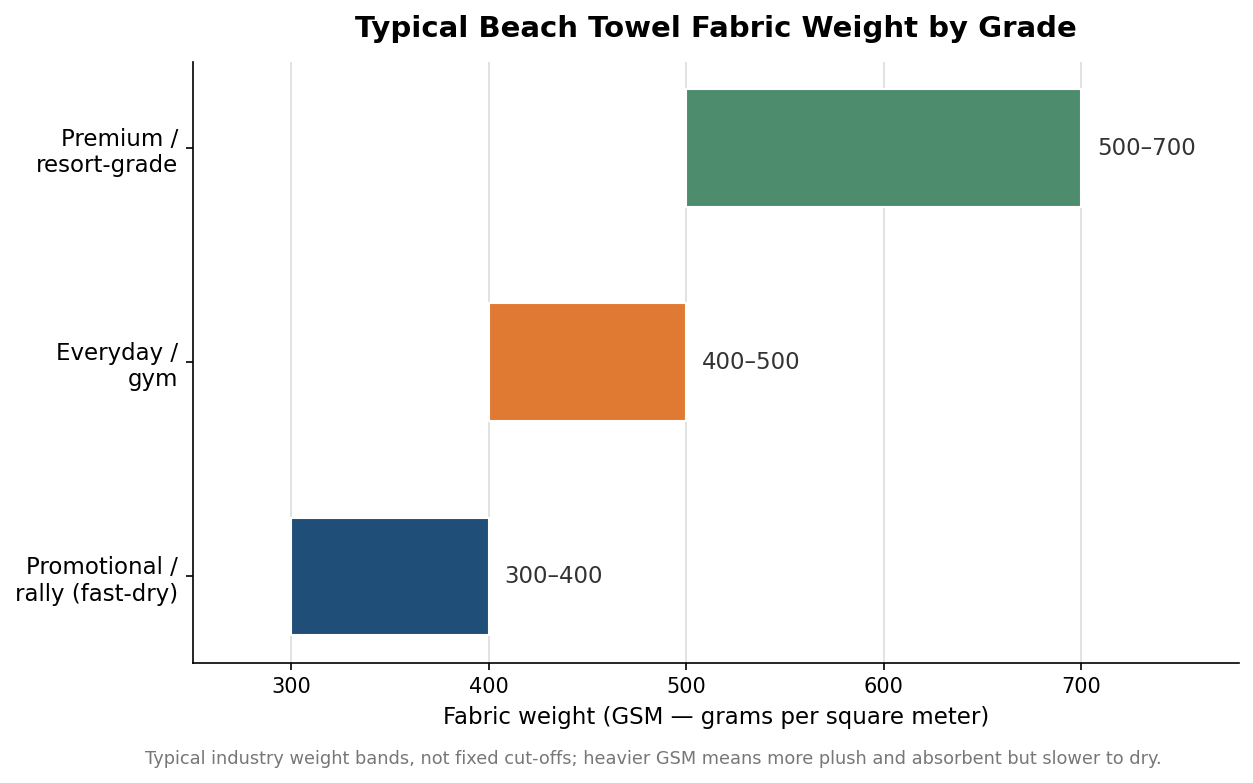
Weight is measured in GSM, or grams per square meter, and it is the single number that most predicts how a towel feels in the hand. Lighter towels dry faster and cost less to make and ship; heavier towels feel plush and absorb more but take longer to dry. For custom beach and promotional towels, the useful range runs from about 300 GSM at the thin, fast-drying end to roughly 700 GSM at the resort-grade end.
As a rough map, promotional and rally-style towels sit around 300 to 400 GSM, everyday and gym towels land near 400 to 500 GSM, and premium retail or resort towels run from about 500 to 700 GSM. These are typical industry bands rather than hard cut-offs, and different mills label their weights slightly differently, so always ask for a physical sample before committing to a large run. If the towel is meant to be sold rather than given away, most buyers are happier landing at 450 GSM or above, because that is the point where the fabric starts to feel like a retail product instead of a handout.
Cotton, velour, or microfiber: match the fabric to the job
Cotton terry is the default for a reason. Ring-spun or combed cotton is soft, highly absorbent, and pleasant against skin, which is why it dominates the beach and bath category. The trade-offs are real: cotton is heavier to ship in bulk and slower to dry, and its looped terry surface slightly softens the edges of any printed graphic because ink sinks into the loops. For a plush, absorbent towel where the design is a logo or bold motif rather than fine detail, cotton terry is hard to beat.
Velour is cotton with a sheared face. The loops on one side are cut to create a smooth, flat surface that takes sharp graphics far better than raw terry, which is why many printed retail towels are terry on the back for absorbency and velour on the front for print quality. Microfiber, usually a polyester or polyamide blend, is the lightweight, quick-drying option favored for sports, travel, and promotional use. It resists shrinking and holds color well, but it is less plush and absorbs less per pass than a high-GSM cotton towel. Blended fabrics such as 70/30 cotton-polyester sit in the middle, resisting shrinkage while keeping much of cotton’s comfort.
Let your artwork choose the print method
The print decision follows from the fabric and the design, not the other way around. Dye sublimation produces full-color, edge-to-edge, photographic results and is the method of choice when the entire towel is the canvas, but it bonds to polyester fibers rather than cotton. That means sublimation belongs on microfiber or a poly-faced velour; attempting it on 100 percent cotton gives washed-out, short-lived color. Sublimation files should generally be supplied at around 300 DPI so fine detail holds.
For cotton, reactive dye printing and screen printing are the workhorses. Reactive and pigment printing uses water-based, often Oeko-Tex certified inks that soak into cotton for a soft hand. Screen printing is the most cost-effective route for bold logos and high-contrast designs once you are ordering in volume, typically becoming economical from around 144 units because the setup cost spreads across the run. If your design is a clean logo in one to three colors, screen printing on cotton terry is usually the most durable and affordable choice; if it is a full-bleed photographic scene, plan on microfiber or velour and sublimation.
Sizing, minimum orders, and lead time
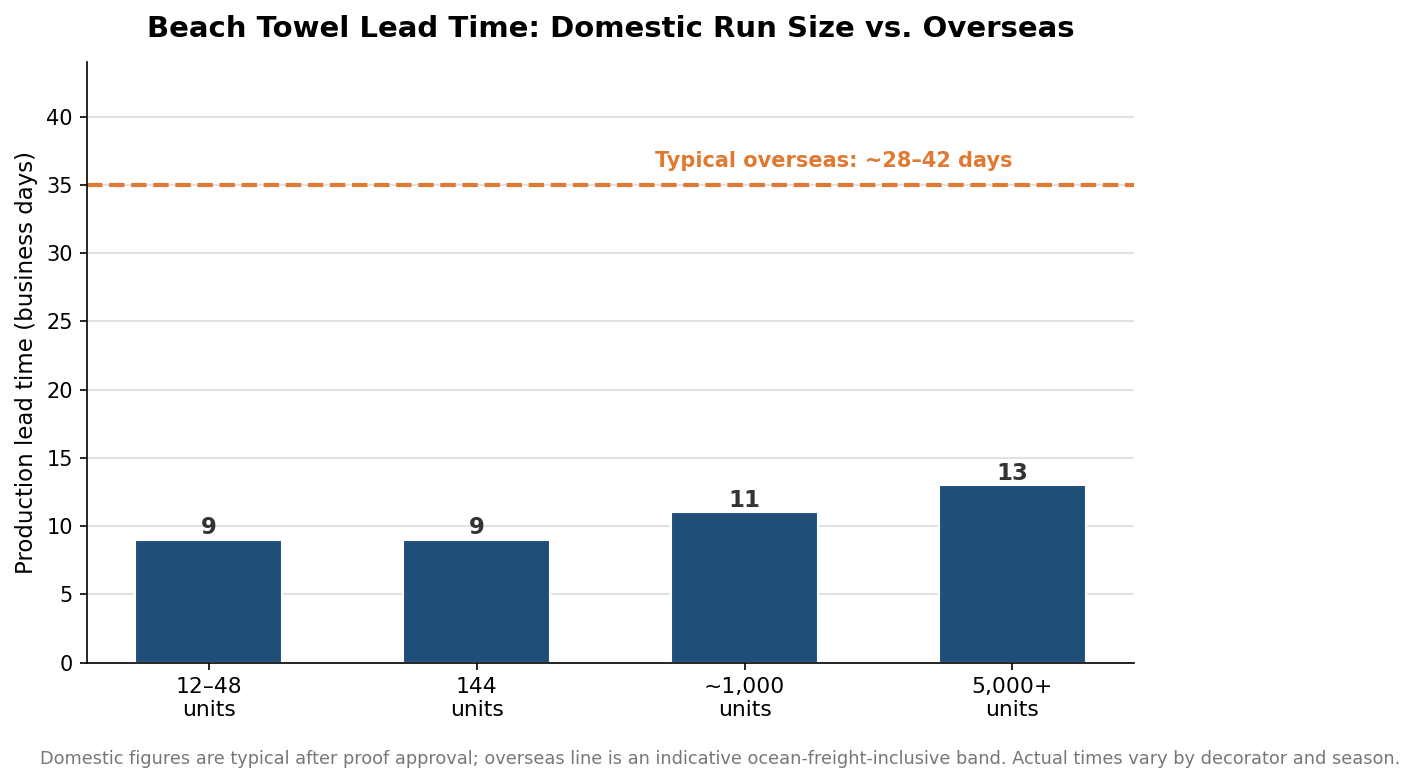
Standard beach towels commonly run about 30 by 60 inches, with oversized versions around 35 by 70 or 40 by 70 inches for a more premium, lounge-friendly footprint. Larger dimensions raise both the fabric cost and the print area, so decide early whether you are making a compact giveaway or a statement retail piece. Minimum order quantities for custom towels can start as low as 12 units for simple styles, with meaningful price breaks appearing at 144 pieces and larger discounts at the 1,000 and 5,000 unit levels as setup and material costs spread further.
Lead time is where domestic and overseas production diverge sharply. A domestic decorator will often turn a run in roughly 7 to 10 business days after proof approval, stretching toward 12 to 14 days for very large orders. Overseas manufacturing can lower the per-unit price on big volumes but typically adds four to six weeks once ocean freight is included, which makes it a poor fit for anything tied to an event date. The figures here are indicative and vary by decorator, season, and how quickly you approve the proof, so treat them as planning ranges rather than guarantees.
Building the spec sheet
When you request a quote, specify all four variables together so the decorator is not guessing: the GSM weight, the fabric type, the finished dimensions, and the print method matched to your artwork. A request that reads “450 GSM cotton terry-velour, 30 by 60 inches, three-color screen print, 250 units” will get you an accurate price and a predictable result. A vague request for “custom beach towels” invites substitutions that surface only when the sample arrives. Order a pre-production sample whenever the run is large or the towel is going to be sold, confirm the ink and fabric certifications if that matters to your buyers, and build your event or launch date backward from the realistic lead time rather than the best case. The towel itself is straightforward; the discipline is in writing the specification down before anyone quotes it.