Once you decide a custom beach towel should carry a full-color design that runs edge to edge, you have quietly made a materials decision as much as an art decision. The print method you can use is dictated by the fiber under it, and the fiber you choose changes how the towel feels, how well it dries, how long the graphic survives the wash, and what it costs. This guide walks through the two dominant routes for branded beach towels, dye sublimation on polyester and dyed or screen printing on cotton, so you can specify the one that matches the job instead of discovering the trade-off after the sample arrives.
Why a full-color towel is really a fiber choice
Print chemistry only bonds to certain fibers. Dye sublimation, the process behind photographic, all-over towel prints, works by turning solid ink into a gas under heat and pressure so it bonds into polyester at a molecular level. That bond is the reason the design cannot crack or peel, but it also means the process needs polyester to bond to. A 100% cotton towel has nothing for sublimation ink to fuse with. Cotton takes color through a different family of methods, reactive and pigment dyeing or screen printing, where the colorant sits in or on the cotton fiber itself. So the first fork is not really “which print looks best,” it is “do I want a polyester-faced towel I can cover in a photo, or a cotton towel I brand more simply.” Everything else follows from that.
Dye sublimation on polyester, and where it stops
Sublimation buys you unlimited color, and asks for a compromise in feel. Because the ink is applied as a gas, sublimation prints unlimited colors, gradients and photo-real images with no per-color charge and no white border, which is why resort, event and retail towels with full artwork are almost always sublimated. The heat step typically runs in the neighborhood of 385 to 400 degrees Fahrenheit for roughly 45 to 60 seconds, though exact settings vary by press and blank. The catch is the surface. To accept the print, the face of the towel is polyester or a high-polyester blend, which feels closer to a resort gift-shop towel than to a plush bath sheet and is modestly less absorbent than pure cotton. A common middle path is a velour towel with a cotton terry loop back for absorbency and a sheared polyester or poly-blend velour face for a smooth, sharp print, which recovers much of the hand feel while keeping the full-color capability.
The cotton route: reactive dye, screen print, and weave
Cotton keeps the plush, absorbent hand most buyers expect from a towel. If the priority is a thick, soft, highly absorbent towel and the artwork is a logo or a limited-color design rather than an edge-to-edge photograph, a cotton terry towel branded by screen printing or reactive dyeing is usually the better fit. Screen printing lays ink onto the loops and is economical for simple designs, typically one to four colors, with a setup or per-color fee; heavy, repeated laundering can eventually cause a thick print to crack. Reactive printing bonds dye into the cotton for a softer result that resists fading. For logos meant to last the life of the towel, a woven or jacquard construction builds the design into the cloth itself rather than printing on top, trading fine detail for near-permanent durability. None of these cotton methods reproduces a gradient-rich photo the way sublimation does, which is exactly the trade-off you are weighing.
Weight and size: reading the numbers on a spec sheet
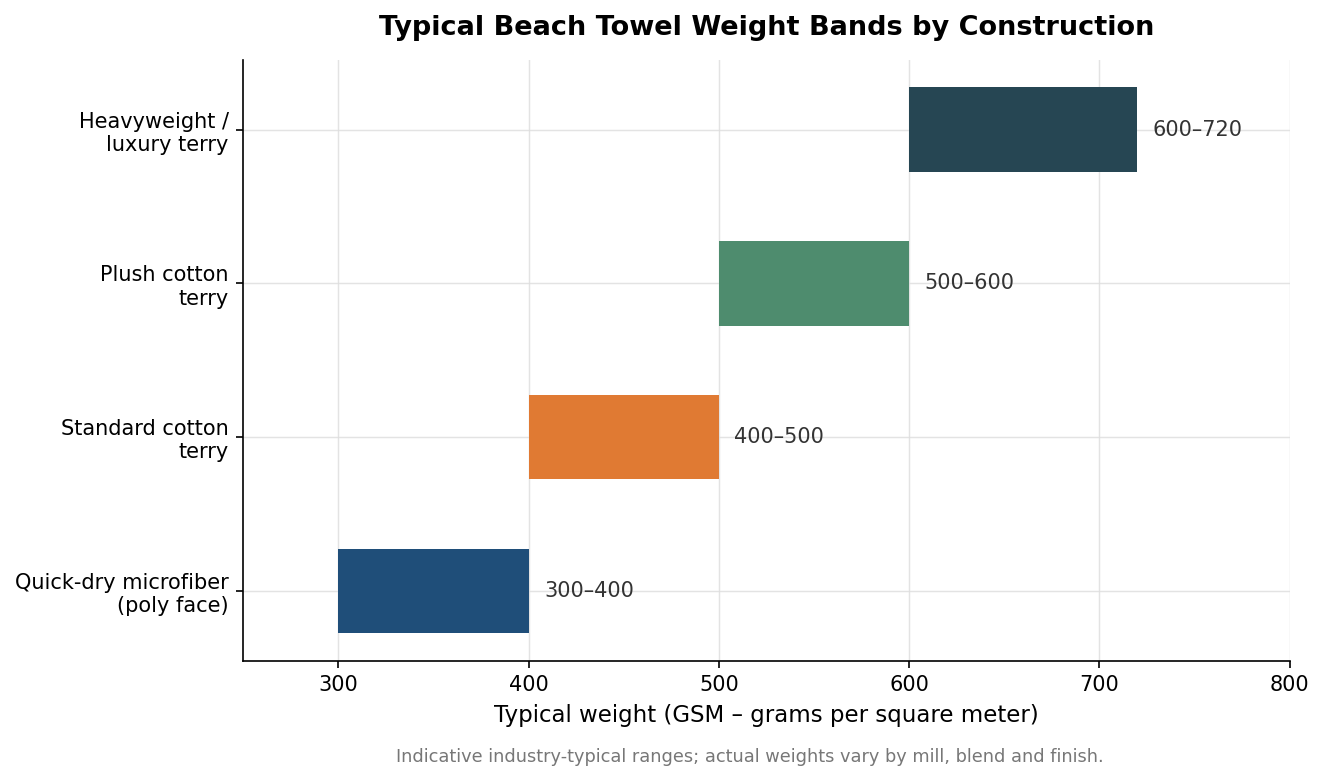
GSM is the single most useful number on a towel quote. GSM, grams per square meter, measures density and tracks closely with how plush, absorbent, heavy and expensive a towel feels. Lightweight quick-dry towels, often the polyester-faced microfiber styles, sit around 300 to 400 GSM and pack down small and dry fast. Standard cotton beach towels land roughly in the 400 to 500 GSM band, plush cotton beach towels around 500 to 600, and heavyweight or luxury terry above 600. Higher GSM means more absorbency and a more substantial feel, at the cost of more weight, slower drying and a higher price. For size, 30 by 60 inches is the common baseline; oversized styles around 35 by 70 or 40 by 70 inches read as more premium and give a photographic print more room, but they raise both fabric cost and shipping weight. The chart below shows the weight bands as indicative ranges rather than fixed cutoffs, because mills, blends and finishes shift them.
Matching the method to the order
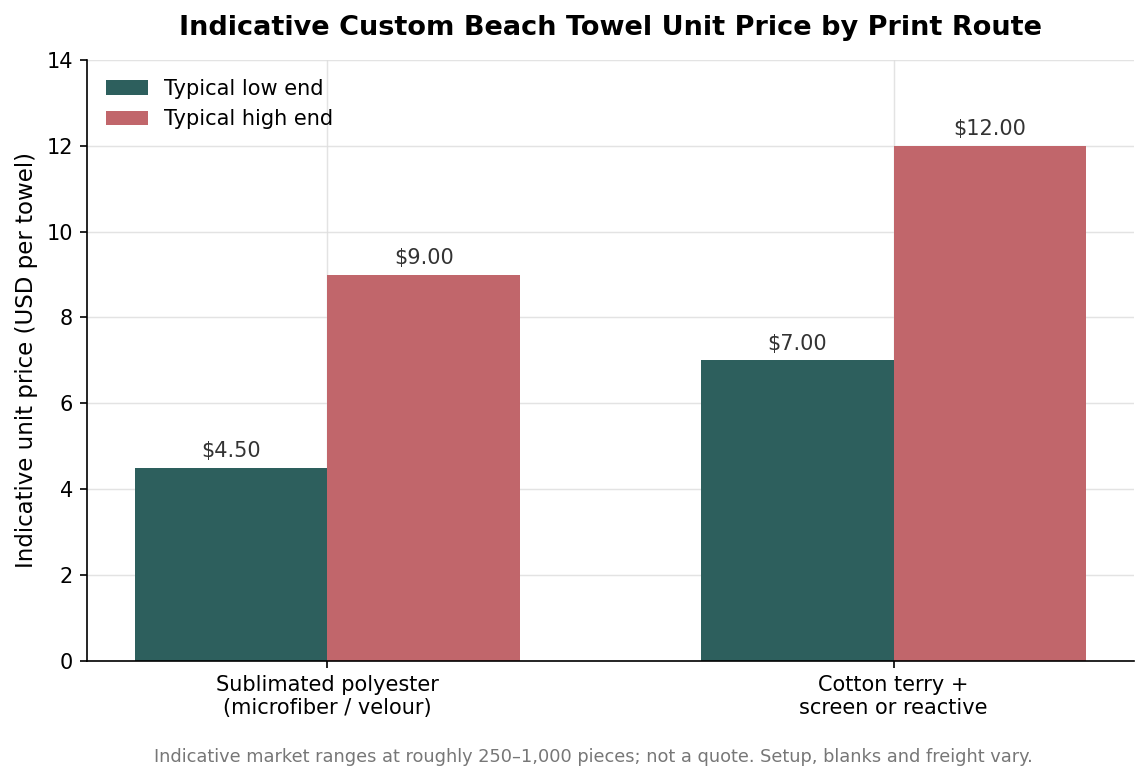
Let the design and the end use pick the method, then let quantity set the budget. If the towel needs full artwork, a gradient, or a photograph and will be used poolside or handed out at an event, sublimated polyester or a velour-faced blend is the practical answer, and you accept a slightly thinner, less plush hand in exchange. If the towel is a giveaway or resale item meant to feel genuinely plush and the branding is a clean logo, cotton terry with a screen or reactive print is the stronger choice. On cost, indicative market pricing tends to run lower for sublimated polyester and higher for cotton with printing, with the exact figure driven by quantity, GSM, size and how many print colors or setups the job needs. Treat the ranges in the chart as planning numbers to frame a conversation with a supplier, not as quotes, and note that setup charges, blank costs and freight sit on top. As a rough planning figure, custom towel programs commonly need a few weeks of production plus transit, so build lead time into any event date and always approve a physical sample before committing to a full run, because color on a screen rarely matches color on terry cloth exactly.
The short version: sublimation gives you unlimited, permanent, edge-to-edge color but a more athletic, resort-style hand on a polyester face, while cotton with reactive or screen printing gives you a plush, absorbent towel with simpler branding. Decide which of those two experiences your recipient should have first, confirm the GSM and size against the numbers above, and the print method mostly chooses itself.