A beach towel has three jobs beyond drying you off, and it either does them or it does not: shed the sand you drag onto it, dry out before you pack it away, and fit in a bag that already holds sunscreen, snacks, and a change of clothes. Whether a towel wins or loses at all three is decided before any logo goes on it, by how the towel is built. Fiber matters, but construction is what makes one towel a sandy, soggy brick and another a shake-and-go favorite. Here is how the main constructions actually perform, and how to pick for the way you use a towel.
The three constructions worth comparing are classic terry, the looped-pile cloth most people picture; flat-woven Turkish cloth, sold as fouta or peshtemal, which has no pile; and microfiber, a synthetic. Each solves the beach’s three problems differently, and none wins on every axis, which is exactly why the right choice depends on the use rather than on which is best in the abstract.
Why sand loves terry, and what sheds it
Sand sticks to terry for a mechanical reason, not a mysterious one. Terry is built from thousands of raised loops, and each loop is a little hook that traps sand grains. You shake the towel, you snap it, and you still carry half the beach home in the pile. This is the same loop structure that makes terry feel plush and absorb so well, so the trait that makes it comfortable is the trait that makes it sandy. There is no shaking your way out of the geometry.
Flat-woven Turkish cloth attacks the problem at the source: with no loops on the surface, there is nothing for sand to catch on, and a single shake releases it. That is the entire appeal of a fouta at the beach. Microfiber sits in the middle, releasing sand better than terry because its surface is smoother and shorter, though not as cleanly as a true flat weave. If a sandless towel is your top priority, construction settles the question before you even look at color.
Drying and weight: the density trade-off
Drying speed tracks density, and density is measured in GSM, the grams per square meter of the cloth. Lightweight towels run about 300 to 400 GSM, medium weights 400 to 600, and plush premium terry climbs into the 600 to 900 range with thick, thirsty loops. More GSM means more absorbency and a more luxurious hand, but it also means more water held and a longer dry. The numbers are stark: a heavy terry beach towel commonly needs roughly 60 to 90 minutes to dry, a Turkish flat weave at 300 to 400 GSM dries in about 30 to 45 minutes, and microfiber at 200 to 300 GSM can be dry in 15 to 30 minutes. The flat weave dries something like 30 to 50 percent faster than terry despite feeling far from thin.
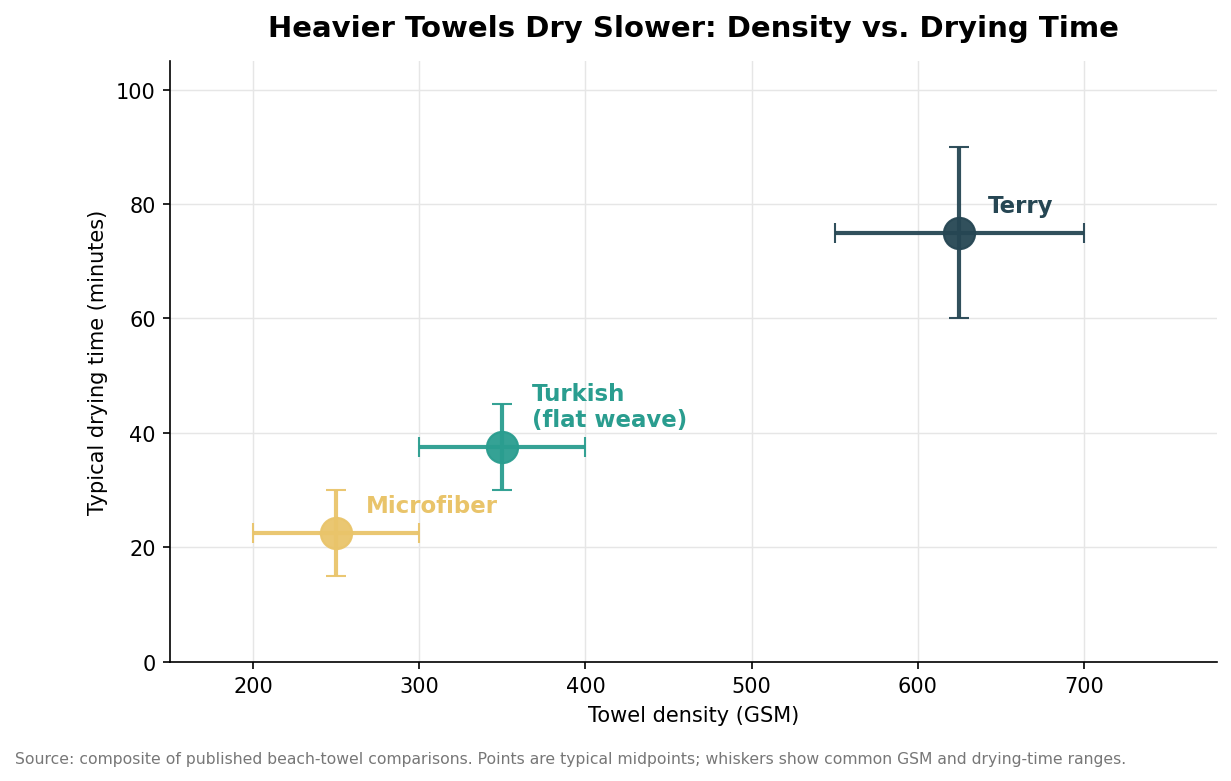
The trade-off has a twist worth knowing. A flat weave hits genuinely useful absorbency at only 300 to 400 GSM because the woven structure spreads water across the whole cloth instead of hiding it in deep loops, which is why a Turkish towel feels far more capable than its weight suggests, and why both Turkish and Turkish cotton generally get softer and more absorbent after a few washes rather than matting down. Terry buys its plushness with weight and pays for it in drying time. Microfiber dries fastest of all but can feel slick or clammy against wet skin, a texture some people never warm to.
What actually fits in the bag
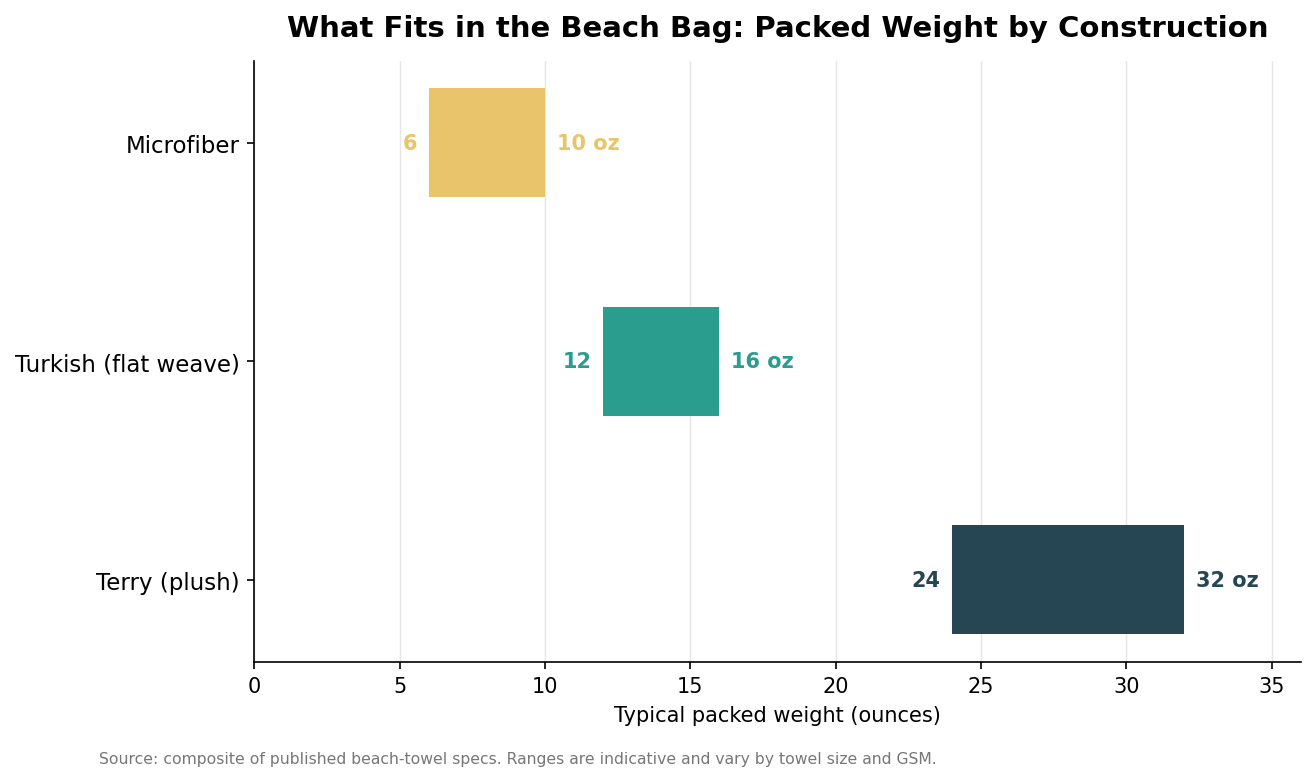
Bulk is the quiet dealbreaker, especially for travel, boats, and anyone carrying towels for a whole family. Packed weight follows the same density logic: a Turkish towel runs roughly 12 to 16 ounces and folds down to about the size of a paperback, microfiber compresses to a fist at 6 to 10 ounces, and a plush terry beach towel lands around 24 to 32 ounces and eats real space in a bag. Multiply that across four people and the difference between a stack of foutas and a stack of terry is the difference between one tote and two.
Durability rounds out the picture and does not always favor the plush option. Flat-woven Turkish cotton is commonly cited as lasting a decade or more and improving with age, terry typically thins over three to five years of hard use, and microfiber tends to pill and hold odor within two to four years. Treat these as indicative rather than promises, since laundering and cotton quality swing them, but the ranking is consistent across sources: for longevity, the flat weave usually wins.
Choosing by how you actually use it
Match the towel to the day and the decision makes itself. For a plush family beach day or a poolside lounge where comfort beats packing and there is time to dry towels at home, mid-to-heavy terry, in the 500 to 700 GSM range, is still the cozy classic. For travel, surf, boat, and festival use where sand, drying, and bulk all matter at once, a Turkish flat weave is the all-around answer, and microfiber is the ultralight pick when packed size trumps feel. For a resort, rental, or gym program, weigh laundering: flat weave lasts and dries fast on the line, while terry delivers the plush guest experience at the cost of dryer time and storage.
One construction note for anyone printing a design rather than a simple logo: a smooth surface holds detail better than a looped one. Flat-woven and sheared velour surfaces render full-color and photographic prints crisply, and microfiber sublimates edge-to-edge full-bleed color that cotton cannot match, whereas a deep terry loop softens fine detail as the pile moves. If the towel is a canvas for artwork, let the print method and the construction be chosen together, not one after the other. Decide which of the three beach problems you most need solved, pick the construction that solves it, and the rest of the spec sheet falls into line.