Most problems with a custom beach towel order are visible before the towels ship, if you know where to look. They come from a handful of predictable decisions made too fast: a weight chosen for the wrong reason, a print method that does not match the fabric, a size that shrinks past what people expected. None of them are exotic, and every one of them costs money on the reorder rather than the first run. Here are the mistakes worth catching early, in the order they tend to bite.
Buying bath weight when you needed beach weight
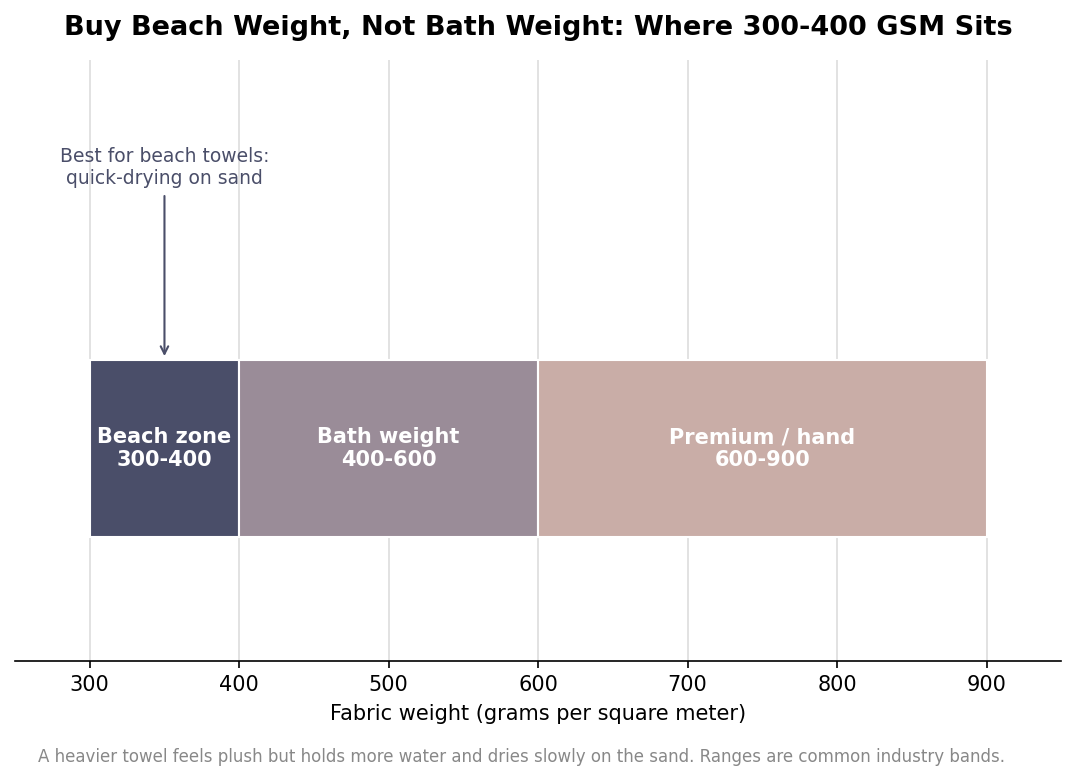
A plush hand feels reassuring in a showroom and works against you on the sand. Beach towels live in the 300 to 400 gram-per-square-meter band for a reason: they are absorbent enough to dry a person but light enough to dry themselves quickly in the sun. Push up into the 400 to 600 range that suits bath towels and you get a denser towel that holds more water and stays damp for hours, which is exactly wrong for a towel that will be soaked, folded into a bag, and expected to be usable again the same afternoon. The 600 to 900 range is denser still and belongs on hand towels, not the beach. Heavier is not more premium here; it is slower to dry and more expensive to ship and launder.
Trying to sublimate cotton
The single most common print mismatch is expecting a photographic, edge-to-edge design on a 100% cotton towel. Dye sublimation, the process behind full-bleed, high-resolution towel graphics, bonds dye to polyester fibers; it needs a polyester or high-polyester face to work, which is why sublimated towels are typically a poly microfiber with a smooth velour print side. Cotton fibers do not accept sublimation dye, so a detailed edge-to-edge print on cotton has to come from a different route, usually reactive printing or screen printing, each with its own limits. Screen printing counts colors: every additional flat color is another screen and another cost, and fine gradients or photographs do not translate well. Reactive printing handles more detail but is a different supply chain and lead time. Decide the artwork first. A bold logo in a few flat colors is comfortable and economical on cotton; a full-coverage photographic print effectively chooses a polyester velour base for you, whether or not that was the plan.
Forgetting that the loops and the back stay white
Full-bleed only means full-bleed on the surface that was printed. On a poly microfiber towel the velour face takes the design edge to edge while the reverse keeps absorbent terry loops, and on many constructions that back is undyed and reads white. On cotton terry, the raised loops scatter a printed image and any hemmed border stays the base color, so a design that looked seamless on a flat proof shows the towel’s ground color in the texture. This is not a defect; it is how the fabrics are built. The fix is to design with it: keep critical logo elements off the extreme edges, expect a visible border on terry, and ask to see the print on the actual loop or velour surface, not just a flat digital mockup.
Ordering the wrong size and ignoring shrinkage
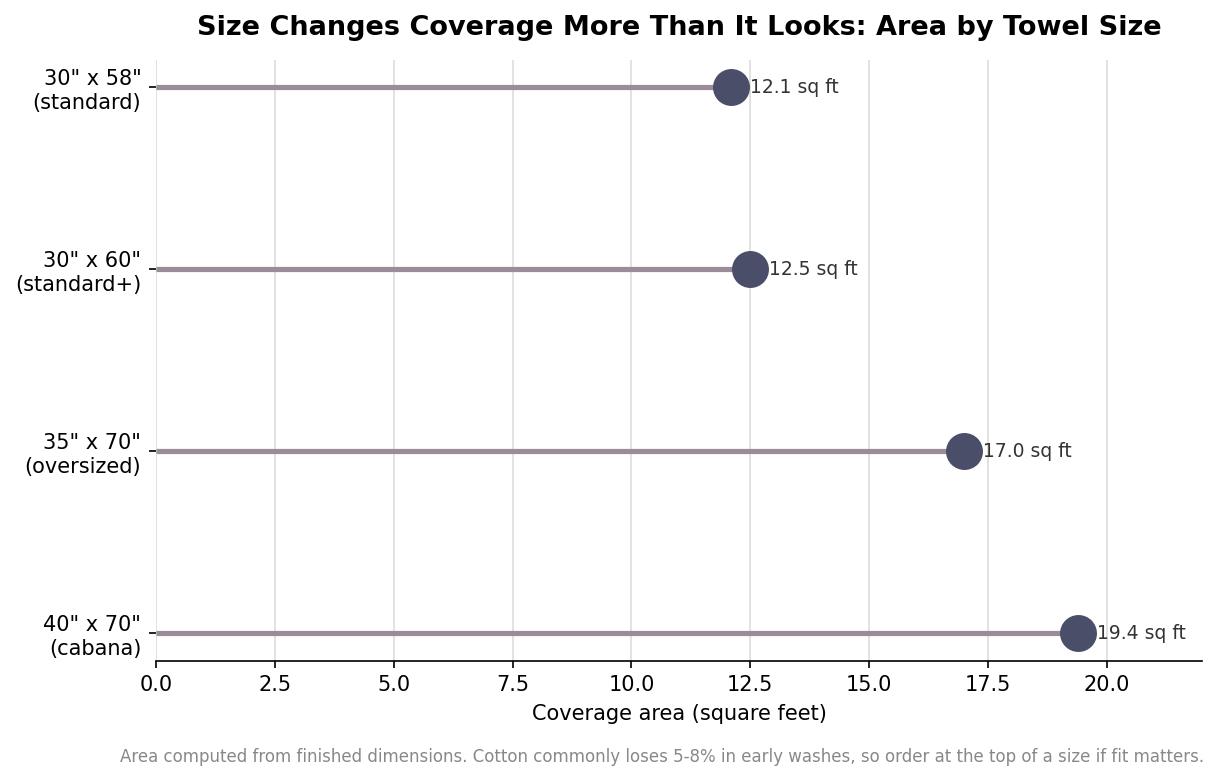
Two towels that sound similar can differ by a third in real coverage. A standard beach towel runs about 30 by 58 to 30 by 60 inches, while an oversized towel at 35 by 70 jumps from roughly 12 square feet of coverage to about 17, and a 40 by 70 cabana size approaches 19. That is a meaningful difference for an adult lying down, and it is worth deciding deliberately rather than defaulting to the cheapest size. Layer shrinkage on top: cotton commonly loses somewhere in the range of 5 to 8 percent in its first few hot washes, so a towel that measures right off the loom can come back noticeably smaller. If finished size matters, specify toward the top of a size and confirm whether the quoted dimensions are pre-wash or post-wash.
Skipping the pre-production sample and a wash test
The cheapest insurance in the whole process is one approved sample before the bulk run. A physical pre-production sample lets you check three things a screen cannot: the actual color against a Pantone reference, the hand and weight of the finished fabric, and how the print and the fabric survive laundering. Run that sample through several wash cycles at the temperature it will really face, then look for fading, cracking on a screen print, or a design that has gone soft at the edges. Low-twist pile absorbs better but can look slightly less crisp under a print, another thing you only judge in hand. Confirm the finished head and tail size, the border route, and the packing at the same time. Catching a color that shifts or a print that cracks on a single sample costs a week; catching it on a delivered pallet costs the whole run.
None of these checks require special expertise, only the discipline to make the decisions in the right order. Fix the weight to how the towel is used, match the print method to the fabric before you fall in love with the artwork, plan around the border and the back you will actually get, size for real coverage after shrinkage, and prove all of it on one sample. Do that and the reorder becomes a repeat of something that worked, rather than a correction of something that did not.