Most custom beach towel decisions get framed as a color and logo problem, but the choice that quietly determines everything is the base fabric. It sets how the towel feels, how fast it dries, how long it survives a laundry cycle, and, crucially, how you are allowed to print on it. Get the base right and the artwork falls into place. Get it wrong and you are fighting the fabric for the life of the order. Three bases cover the overwhelming majority of custom work: cotton terry, a cotton-polyester blend, and microfiber.
The fiber decides the print method, not the other way around
This is the rule that trips up first-time buyers. Dye sublimation, the process behind photo-realistic, edge-to-edge towel designs with no white border, bonds dye directly into polyester fibers. It only works where there is polyester to bond to. A 100 percent cotton towel cannot be sublimated, so its artwork is applied by screen printing or reactive dyeing instead, which handles crisp logos and a handful of spot colors well but cannot reproduce gradients or full-bleed photography. If your design is a bold multicolor pattern that runs to the edge, you are choosing a polyester-bearing base whether you thought about it that way or not. If your design is a clean one to four color logo, cotton is back on the table.
Cotton terry: the plush, absorbent classic
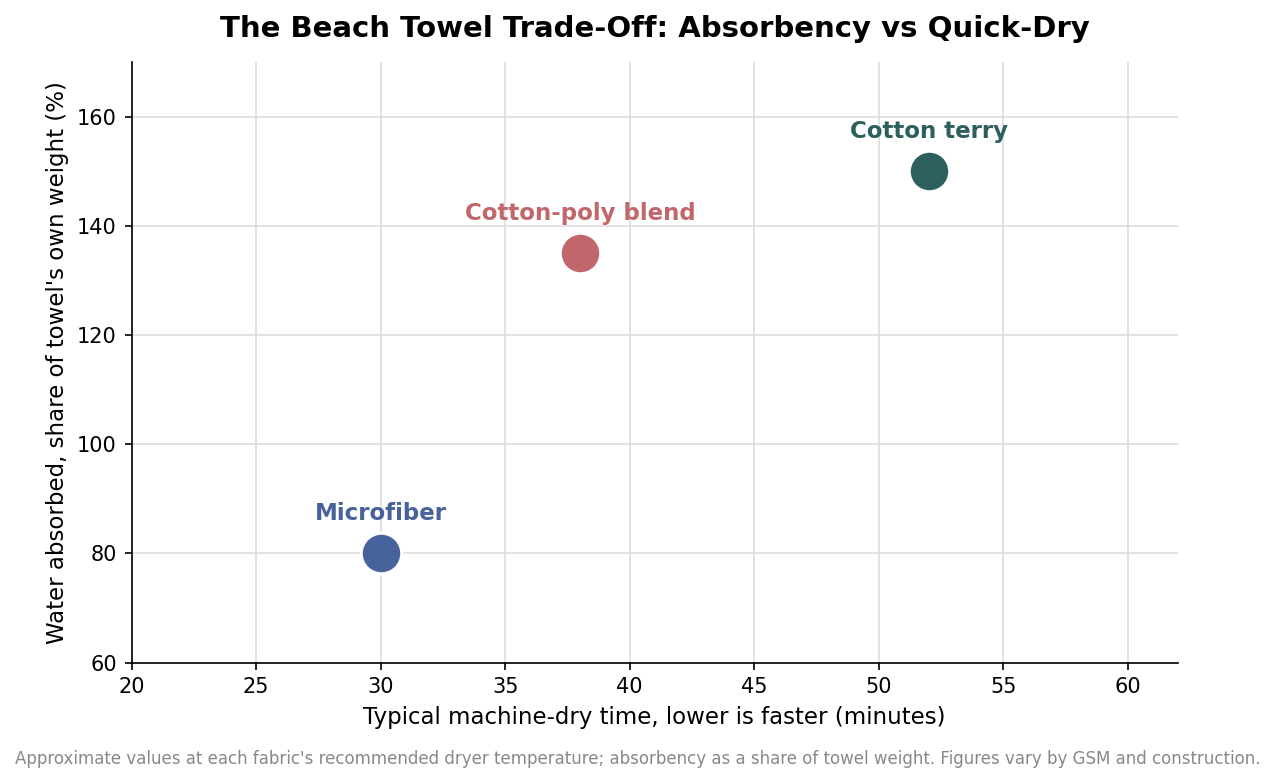
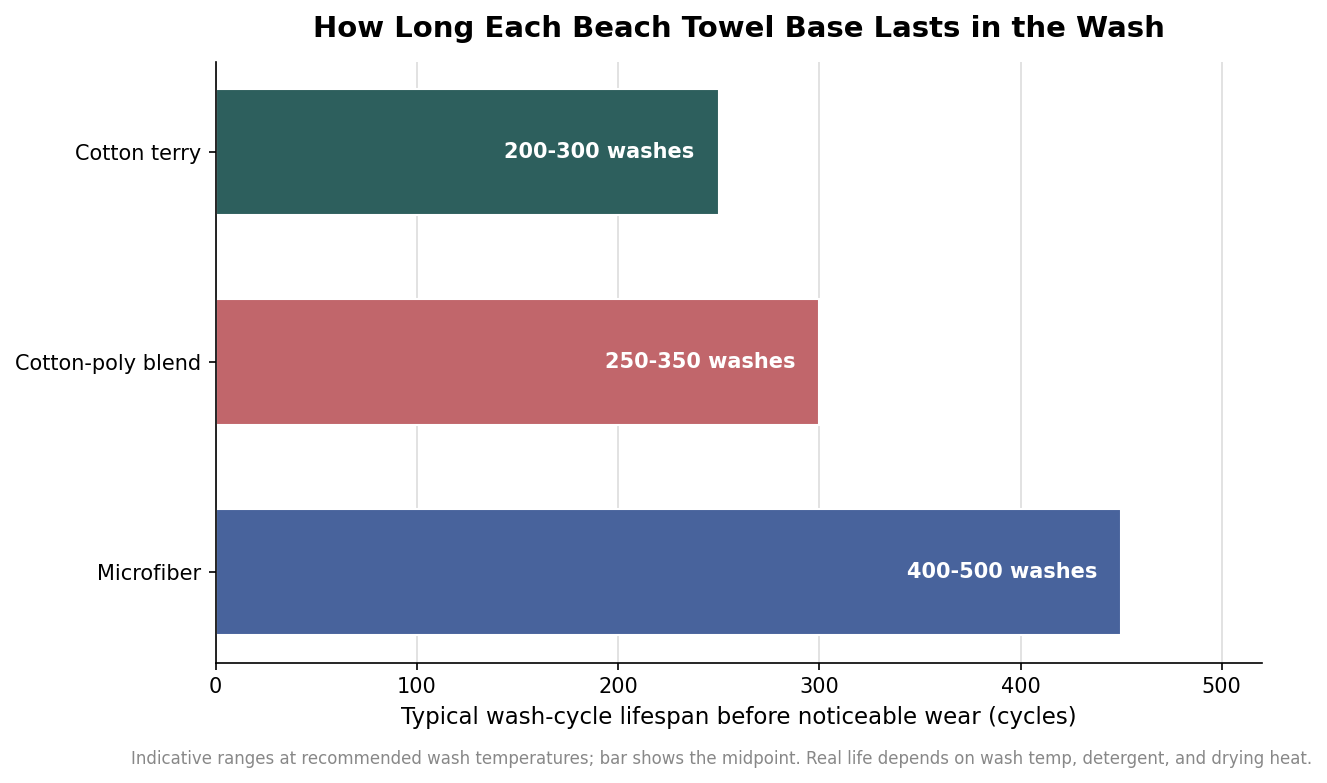
Cotton terry is what people picture when they think beach towel. The looped pile gives it the plush hand and the highest absorbency of the three, holding on the order of one and a half times its own weight in water. Beach weights typically land between 450 and 600 GSM, with the heavier end reserved for spa and resort programs where a thick towel signals quality. The trade-offs are weight and drying: a soaked terry towel is heavy in a bag and can take a couple of hours to air dry. Decoration is screen print or embroidery, so keep the artwork to logos and simple graphics, and expect a printed design to soften with heavy laundering over roughly 200 to 300 wash cycles. Cotton is usually the premium option on price as well, often the most expensive base per piece.
Cotton-polyester blend: the practical middle
A blend, commonly around 70 percent cotton and 30 percent polyester, is the pragmatic choice for programs that get washed constantly. It keeps most of the cotton hand and roughly 90 percent of cotton’s absorbency while drying about a quarter faster, and it tends to run 15 to 20 percent cheaper than premium cotton. Its real advantage shows up over time: where pure cotton can fall to around 70 percent of its original absorbency after 200 washes, a good blend holds closer to 85 percent. For hotels, gyms, and rental fleets that value durability and laundry turnaround over maximum plushness, the blend is often the smartest total-cost decision even though it never wins a single spec outright.
Microfiber: lightweight, quick-dry, and built for sublimation
Microfiber, usually an 80 percent polyester and 20 percent nylon weave around 300 GSM, is the travel and event towel. It is thin and packable, dries three to five times faster than cotton, and because it is largely polyester it takes dye sublimation beautifully, which is why the vibrant, full-coverage promotional towels you see are almost always microfiber or sublimation-grade polyester. It is also the most wash-durable of the three, often lasting 400 to 500 cycles. The honest downsides are feel and absorbency: it holds only about 80 percent of its own weight in water and has a smoother, less plush hand than terry. For a giveaway, a race, a gym, or anything that has to fit in a backpack, that is a fair trade. For a luxury pool experience, it is not.
Care is part of the spec, not an afterthought
How the towels are washed determines whether your base performs to its rating. Cotton and blends are happiest around 140 degrees Fahrenheit, roughly 60 Celsius, which sanitizes and lifts oils without cooking the fibers; push much past 160 degrees and you start breaking cotton down and shortening the lifespan you paid for. Microfiber is the opposite temperament and wants cooler water, in the range of 105 to 120 degrees, because high heat can glaze its fibers and kill the quick-dry behavior that was the whole reason you chose it. Skip fabric softener on every base, since it coats the fibers and is the single fastest way to destroy absorbency, and keep dryer heat moderate. Spelling this out for whoever launders the towels, whether that is a hotel service or a customer care card, protects the wash-cycle numbers on the chart above from turning into optimistic fiction.
Matching GSM and base to the job
Weight should follow the use case rather than a default. As a rough guide, resort and hotel beach towels sit comfortably in the 400 to 500 GSM range, gym and event towels do their job at 300 to 400 GSM where lighter and quick-drying is a feature, and spa towels climb to 500 to 600 GSM where plushness is the point. Layer the print method on top of that: if the brief calls for a full-bleed photographic design, plan on a polyester or microfiber base and dye sublimation from the start, and if it calls for a sharp logo on a premium feel, cotton terry with screen print or embroidery is the natural fit. Confirm the exact GSM, fiber content, and decoration method on your quote before you approve anything, because those three numbers, more than the price, are what you will live with every time the towel comes out of the wash.